Inorganic Chemicals Industry ›› 2026, Vol. 58 ›› Issue (3): 106-111.doi: 10.19964/j.issn.1006-4990.2025-0064
• Environment·Health·Safety • Previous Articles Next Articles
Study on preparation of glass-ceramics from titanium-bearing blast furnace slag synergized with nickel-iron slag
ZHU Qingde1,2( ), ZHU Rong1(), MU Jinwen2
- 1.Institute for Carbon Neutrality,University of Science and Technology Beijing,Beijing 100083,China
2.Gansu Jiu Steel Group Hongxing Iron & Steel Co. ,ltd. ,Jiayuguan 735100,China
-
Received:2025-02-12Online:2026-03-10Published:2025-07-14 -
Contact:ZHU Rong E-mail:zhuqingde@jiugang.com;zhurong1201@126.com

CLC Number:
Cite this article
ZHU Qingde, ZHU Rong, MU Jinwen. Study on preparation of glass-ceramics from titanium-bearing blast furnace slag synergized with nickel-iron slag[J]. Inorganic Chemicals Industry, 2026, 58(3): 106-111.
share this article
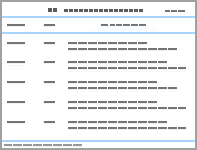
Table 1
Main chemical compositions of raw materials %"
| 成分 | w (Al2O3) | w(SiO2) | w (Fe2O3) | w(CaO) | w (MgO) | w (TiO2) | w (K2O) | w (Na2O) | w (Cr2O3) |
|---|---|---|---|---|---|---|---|---|---|
| TBFS | 13.10 | 26.50 | 4.85 | 28.60 | 7.64 | 18.24 | 0.36 | 0.71 | |
| NS | 4.98 | 52.50 | 7.05 | 1.30 | 32.50 | 0.21 | 0.14 | 0.31 | 0.97 |
| WG | 0.70 | 72.10 | 0.15 | 8.41 | 5.07 | 0.29 | 13.27 |
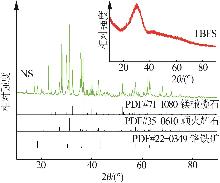
Fig.1
XRD patterns of TBFS and NS"
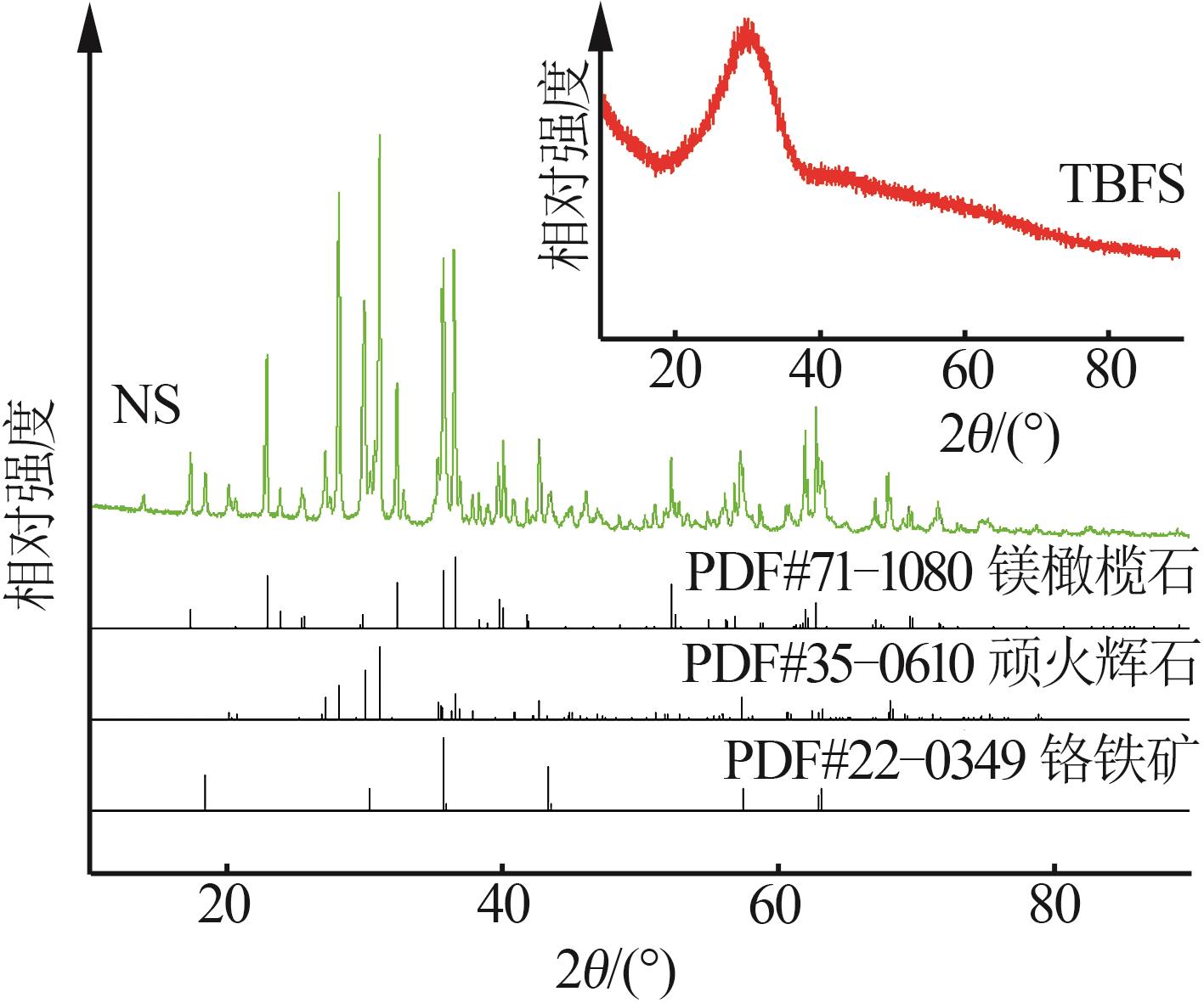
Table 2
Chemical composition contents of basic glasses %"
| 编号 | w(SiO2) | w(CaO) | w(MgO) | w (Al2O3) | w (K2O) | w (Na2O) | w (Fe2O3) | w (TiO2) | w (Cr2O3) |
|---|---|---|---|---|---|---|---|---|---|
| N20 | 45.33 | 17.11 | 11.86 | 7.76 | 0.29 | 4.36 | 3.89 | 9.21 | 0.19 |
| N30 | 47.93 | 14.38 | 14.36 | 6.95 | 0.27 | 4.31 | 4.11 | 7.40 | 0.29 |
| N40 | 50.53 | 11.65 | 16.86 | 6.14 | 0.24 | 4.26 | 4.34 | 5.59 | 0.39 |
| N50 | 53.14 | 8.92 | 19.37 | 5.33 | 0.21 | 4.21 | 4.55 | 3.78 | 0.49 |
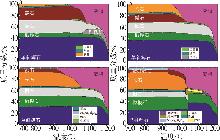
Fig.2
Thermodynamic equilibrium calculation results of different samples"
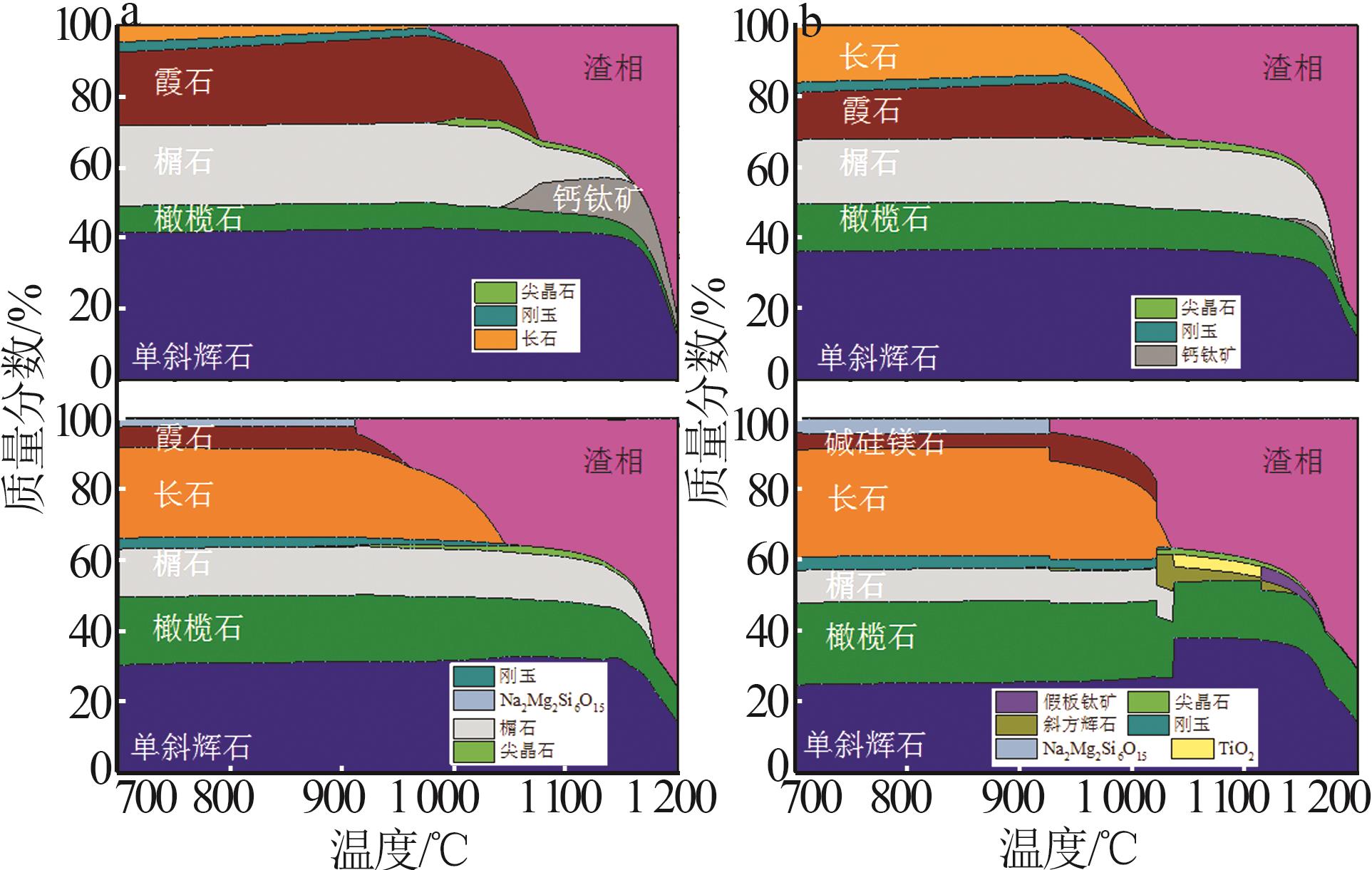
Fig.3
DTA and DTA derivative curves of glasses with varying slag ratio"
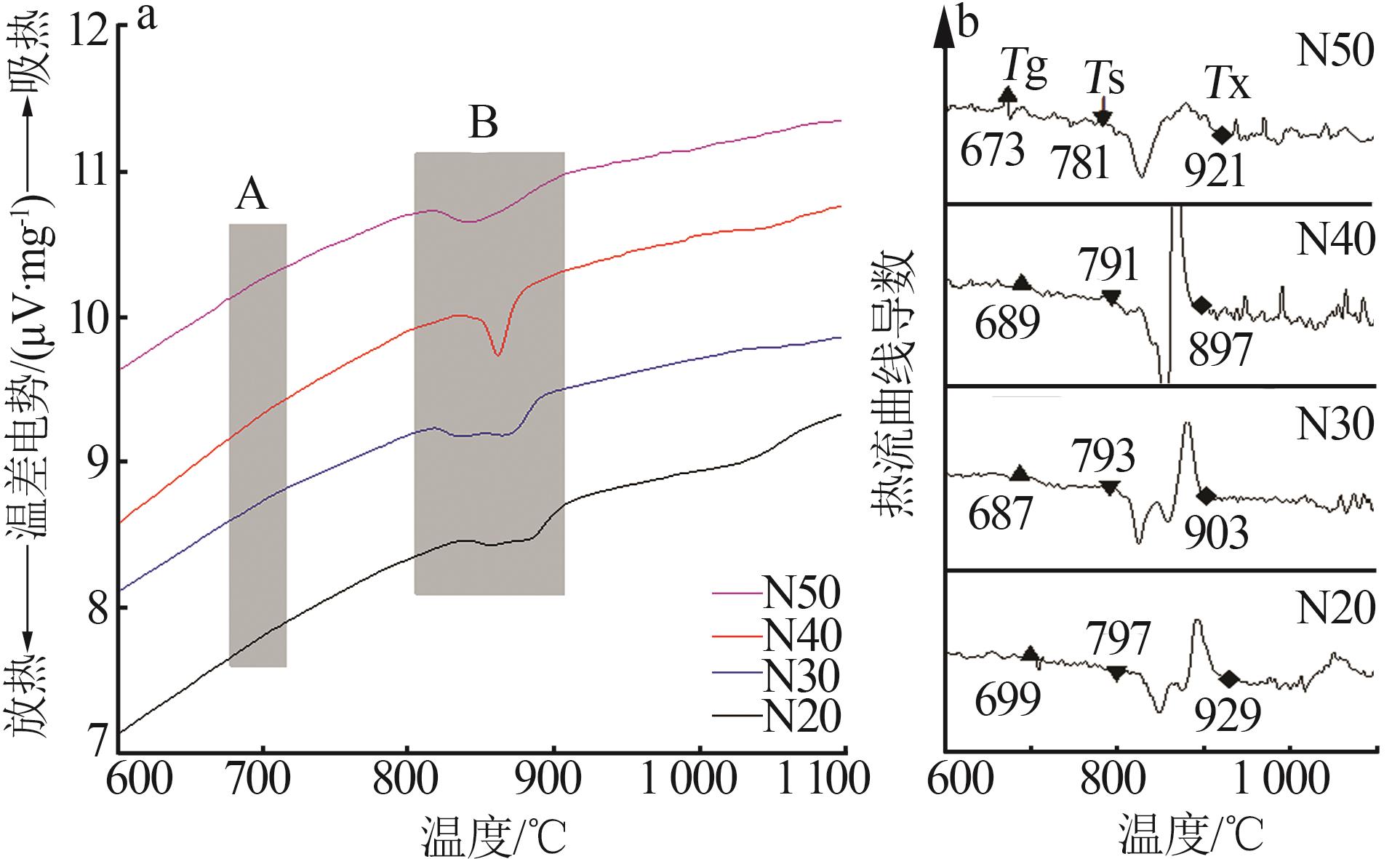
Fig.4
XRD patterns of glass-ceramics crystallized at 950 ℃ with varying slag ratios"
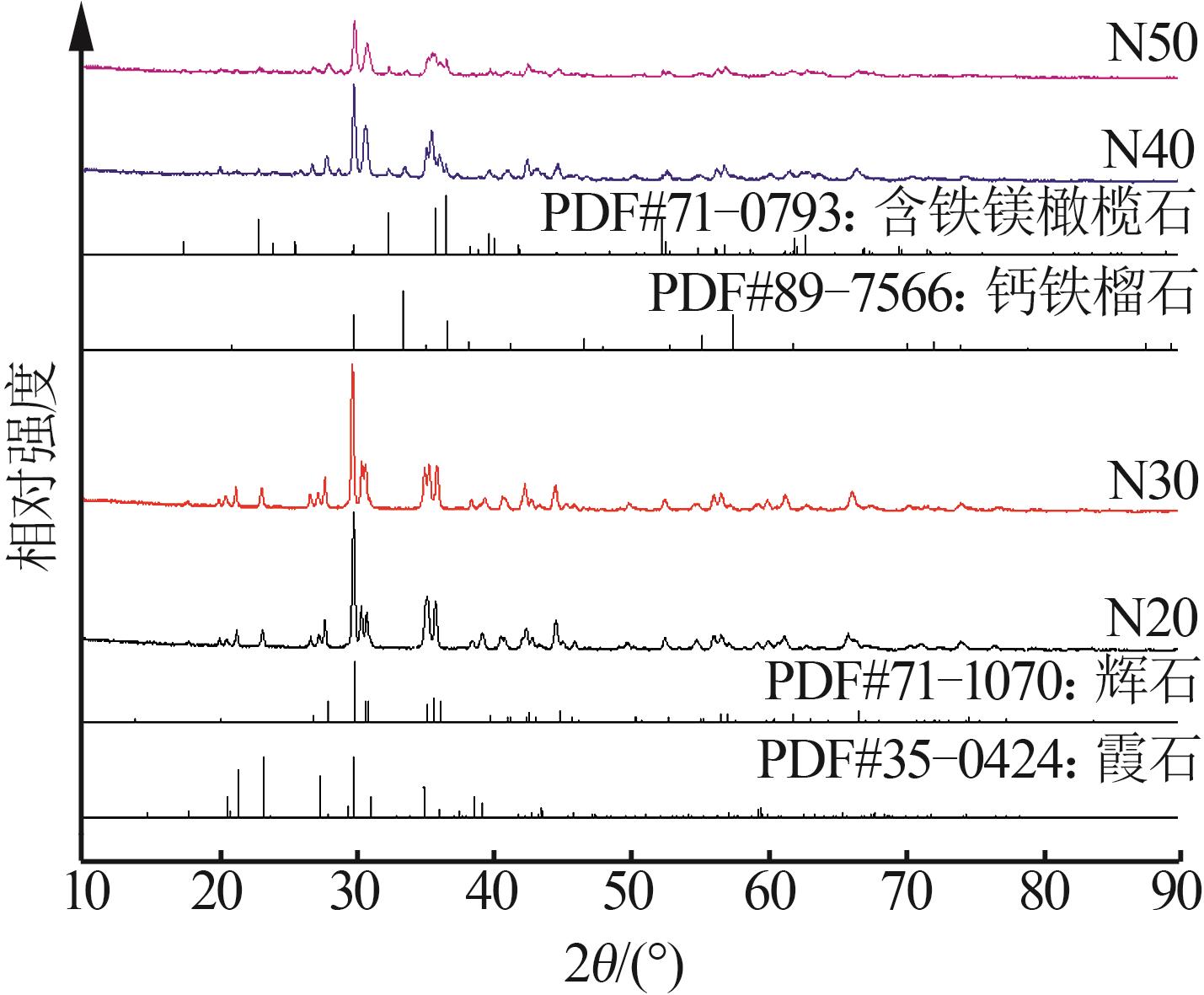
Fig.5
SEM-EDS of glass-ceramics crystallized at 950 ℃ with varying slag ratios"
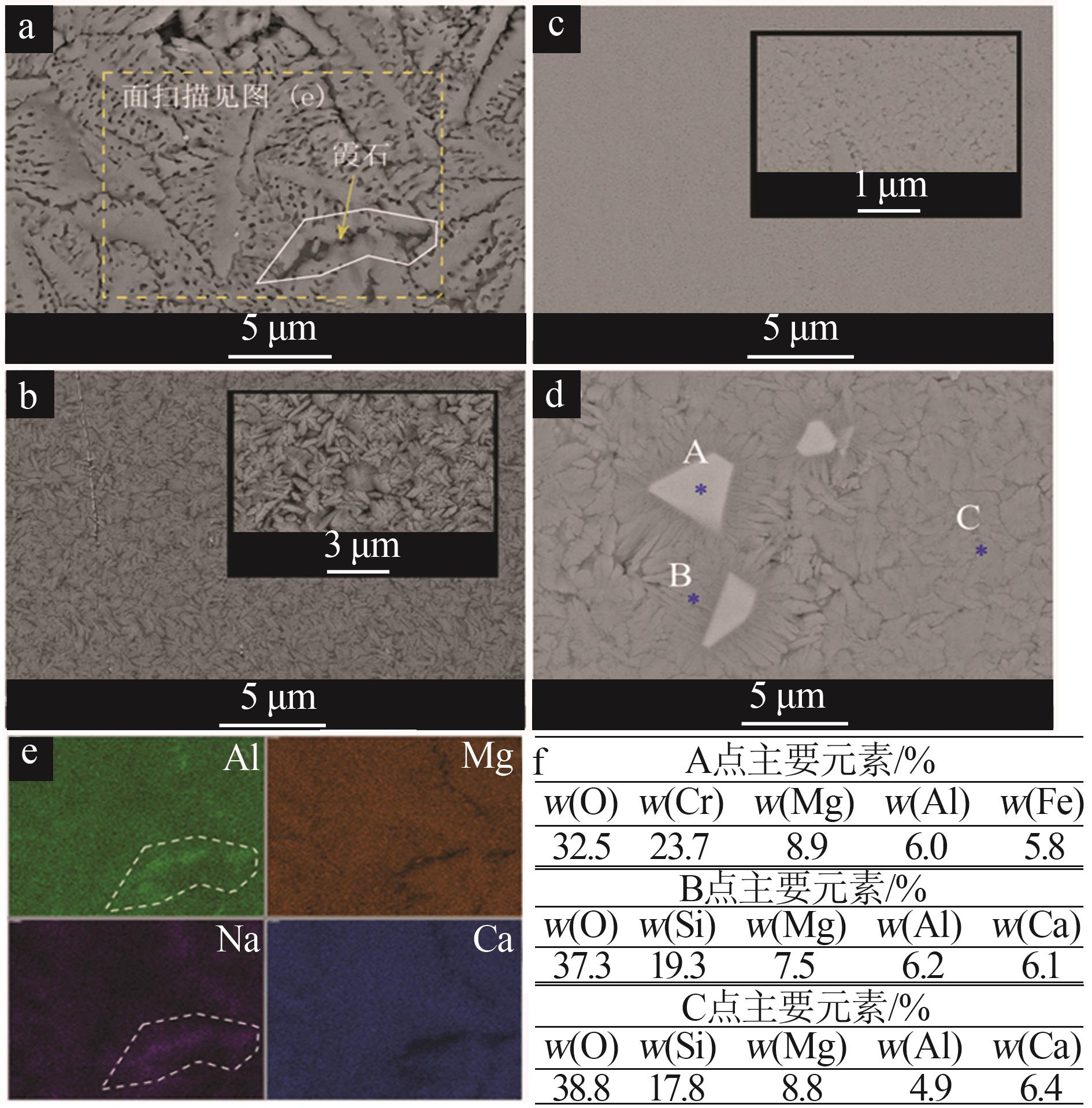
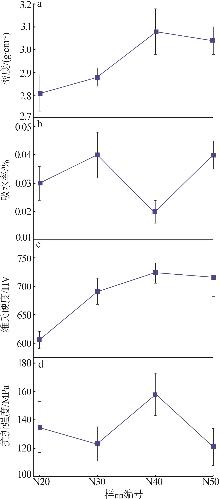
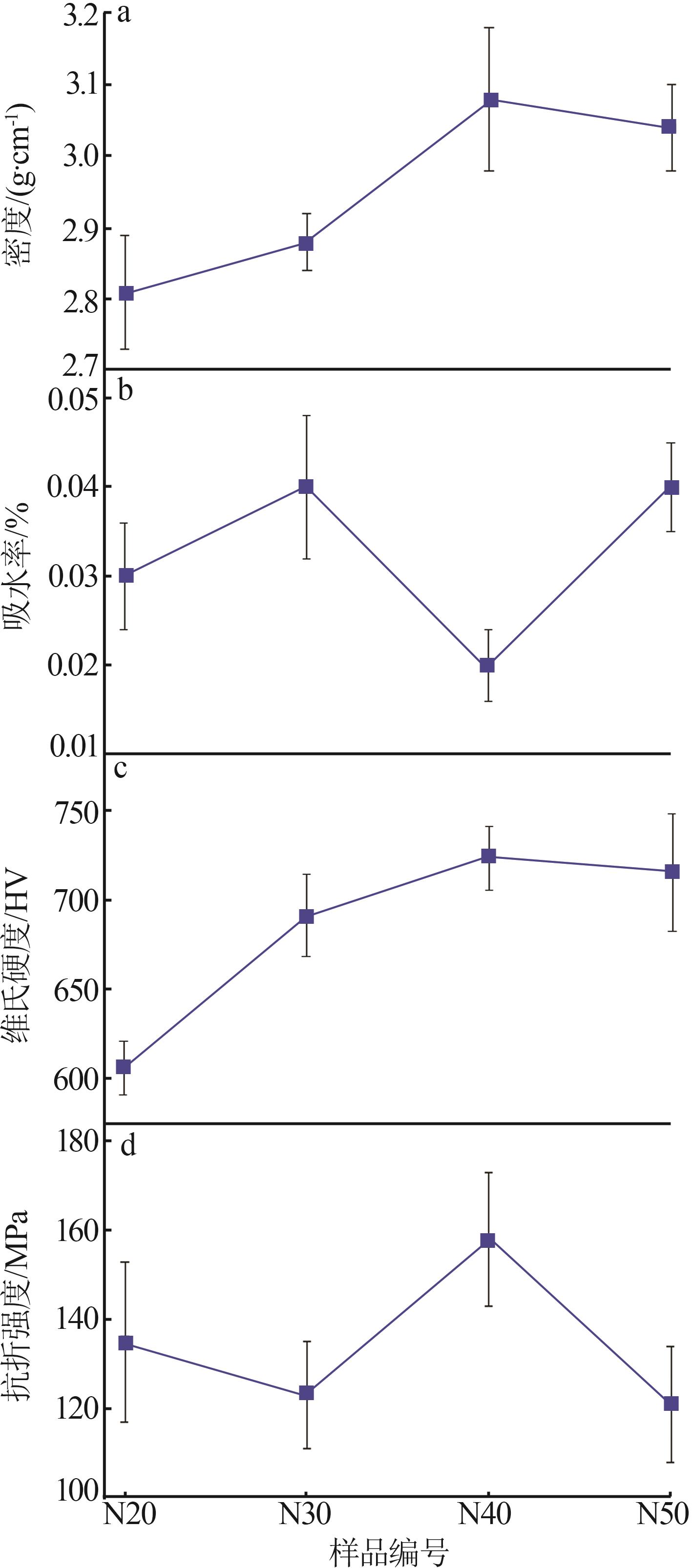
Fig.6
Physical performances of glass-ceramics crystallized at 950 ℃ with varying slag ratios"
| [1] | 邓磊波.铁尾矿及高炉渣制备玻璃陶瓷的结构与性能研究[D].包头:内蒙古科技大学,2023. |
| DENG Leibo.Research on the structure and propertiesof glass ceramics prepared from irontailings and blast furnace slag[D].Bao-tou:Inner Mongolia University of Science and Technology,2023. | |
| [2] | 蒋子文,全学军,李纲,等.铬渣资源化利用研究进展[J].无机盐工业,2023,55(2):26-35. |
| JIANG Ziwen, QUAN Xuejun, LI Gang,et al.Research Progress of Resource Utilization of Chromium Slag[J].Inorganic Chemicals Industry,2023,55(2):26-35. | |
| [3] | 徐文珍,李灿华,季洪峰,等.赤泥在回收金属和建筑材料领域的研究进展[J].无机盐工业,2023,55(2):10-18,44. |
| XU Wenzhen, LI Canhua, JI Hongfeng,et al.Research progress of red mud in field of recycled metals and building materials[J].Inorganic Chemicals Industry,2023,55(2):10-18,44. | |
| [4] | 李小明,张欣华,邢相栋.响应曲面法优化二次镍渣微晶玻璃热处理制度[J].有色金属(冶炼部分),2024(7):116-123. |
| LI Xiaoming, ZHANG Xinhua, XING Xiangdong.Optimization of heat treatment schedule of secondary nickel slag microcrystalline glass by response surface method[J].Nonferrous Metals(Extractive Metallurgy),2024(7):116-123. | |
| [5] | 胡金,姚明灿,钟通,等.B2O3对含钛高炉渣熔体微观结构与输运性质的影响[J].有色金属(冶炼部分),2024(1):41-53. |
| HU Jin, YAO Mingcan, ZHONG Tong,et al.Effect of B2O3 on microstructure and transport properties of melt titanium-containing blast furnace slag[J].Nonferrous Metals(Extractive Metallurgy),2024(1):41-53. | |
| [6] | DIAMANTOPOULOS G, KATSIOTIS M, FARDIS M,et al.The role of titanium dioxide on the hydration of Portland cement:A combined NMR and ultrasonic study[J].Molecules,2020,25(22):5364. |
| [7] | LE CORNEC D, GALOISY L, IZORET L,et al.Structural role of titanium on slag properties[J].Journal of the American Ceramic Society,2021,104(1):105-113. |
| [8] | 许莹,李单单,杨姗姗,等.含钛高炉渣综合利用研究进展[J].矿产综合利用,2021(1):23-31. |
| XU Ying, LI Dandan, YANG Shanshan,et al.Research progress of comprehensive utilization of Ti-bearing blast furnace slag[J].Multipurpose Utilization of Mineral Resources,2021(1):23-31. | |
| [9] | JIAO Mengjiao, WU Hangmi, LI Zhuoyang,et al.Effect of Cr2O3 on the crystallization,structure,and properties of Ti-bearing blast furnace slag-based glass ceramics[J].Journal of Asian Ceramic Societies,2021,9(3):1320-1330. |
| [10] | 王钦,王娜,黄欣,等.微晶玻璃研究进展[J].无机盐工业,2022,54(8):1-11. |
| WANG Qin, WANG Na, HUANG Xin,et al.Research progress on glass-ceramics[J].Inorganic Chemicals Industry,2022,54(8):1-11. | |
| [11] | REZVANI M, EFTEKHARI-YEKTA B, SOLATI-HASHJIN M,et al.Effect of Cr2O3,Fe2O3 and TiO2 nucleants on the crystallization behaviour of SiO2-Al2O3-CaO-MgO(R2O) glass-ceramics[J].Ceramics International,2005,31(1):75-80. |
| [12] | BACK G S, YOON M J, JUNG W G.Effect of the Cr2O3 and TiO2 as nucleating agents in SiO2-Al2O3-CaO-MgO glass-ceramic system[J].Metals and Materials International,2017,23(4):798-804. |
| [13] | TAKAV P, BANIJAMALI S, SEDAGHAT AHANGARI HOSSEIN ZADEH A,et al.Influence of TiO2 content on phase evolution,microstructure and properties of fluorcanasite glass-ceramics prepared through sintering procedure for dental restoration applications[J].Ceramics International,2018,44(6):7057-7066. |
| [14] | WANG Chengyu, JIA Huichao, WANG Aiping,et al.Effect of TiO2 on the crystallization and properties of MgO-Al2O3-SiO2 glass-ceramics prepared by an “one-step” method from laterite ore[J].Ceramics International,2019,45(4):5133-5138. |
| [15] | WEBSTER R I, OPILA E J.The effect of TiO2 additions on CaO-MgO-Al2O3-SiO2(CMAS) crystallization behavior from the melt[J].Journal of the American Ceramic Society,2019,102(6):3354-3367. |
| [16] | CAI Yongfeng, SONG Ningning, YANG Yunfei,et al.Recent progress of efficient utilization of titanium-bearing blast furnace slag[J].International Journal of Minerals,Metallurgy and Materials,2022,29(1):22-31. |
| [17] | HE Dongfeng, GAO Chong, PAN Jiangtao,et al.Preparation of glass-ceramics with diopside as the main crystalline phase from low and medium titanium-bearing blast furnace slag[J].Ceramics International,2018,44(2):1384-1393. |
| [18] | SHANG Wenxing, PENG Zhiwei, HUANG Yawen,et al.Production of glass-ceramics from metallurgical slags[J].Journal of Cleaner Production,2021,317:128220. |
| [19] | CHEN Lishun, LONG Yuting, ZHOU Mingkai,et al.Structure and crystallization of high-calcium,CMAS glass ceramics synthesized with a high content of slag[J].Materials,2022,15(2):657. |
| [20] | HUANG Xiaofeng, ZHAO Wei, GUO Hongwei,et al.Crystallization enhancement and microstructure evolution characteristics of Ti-bearing blast furnace slag glass-ceramics with the introduction of ferrochromium slag[J].SSRN Electronic Journal,2023,49(6):9708-9718. |
| [21] | 曲涛,谷旭鹏,施磊,等.高镁硅红土镍矿开发利用研究现状[J].材料导报,2020,34(S1):261-267. |
| QU Tao, GU Xupeng, SHI Lei,et al.Research status of development and utilization of garnierite[J].Materials Reports,2020,34(S1):261-267. | |
| [22] | 吴渊,张培伟,钱佳晨,等.富镁镍渣-偏高岭土基地质聚合物的制备及耐火性能研究[J].新型建筑材料,2024,51(8):117-122. |
| WU Yuan, ZHANG Peiwei, QIAN Jiachen,et al.Preparation and refractory properties of high-magnesium nickel slag-metakaolin based geopolymer[J].New Building Materials,2024,51(8):117-122. | |
| [23] | 张文博,何桥鹏,张佳音,等.废渣微晶玻璃的制备及其着色机制[J].中国陶瓷,2025,61(2):53-61,66. |
| ZHANG Wenbo, HE Qiaopeng, ZHANG Jiayin,et al.Preparation and coloring mechanism of waste slag glass-ceramics[J].China Ceramics,2025,61(2):53-61,66. | |
| [24] | HUANG Xiaofeng, SUN Ziang, FANG Jie,et al.Effect of sintering behavior and phase evolution on glass-ceramics entirely derived from ferrochrome slag and fluorite tailings[J].Ceramics International,2024,50(22):48724-48735. |
| [25] | KUENZEL C, GROVER L M, VANDEPERRE L,et al.Production of nepheline/quartz ceramics from geopolymer mortars[J].Journal of the European Ceramic Society,2013,33(2):251-258. |
| [26] | LAZIRI K, DJEMLI A, REDAOUI D,et al.Kinetics of formation,microstructure,and properties of monolithic forsterite(Mg2SiO4) produced through solid-state reaction of nano-powders of MgO and SiO2 [J].Ceramics International,2024,50(22):45179-45188. |
| [1] | GAO Huafeng, DONG Linlin, LIU Wei. Study on preparation of portland cement clinker from zinc tailings and its Zn2+ solidification [J]. Inorganic Chemicals Industry, 2025, 57(9): 110-116. |
| [2] | SI Bin, XUE Miaomiao, ZHAO Yali. Study on burning characteristics and hydration properties of portland cement clinker doped with lithium slag [J]. Inorganic Chemicals Industry, 2025, 57(7): 120-126. |
| [3] | YANG Minhang, XU Kai, CHENG Huaigang, CHENG Wenting, SONG Huiping. Regular study on effect of impurity ions in brine on morphology of magnesium sulfate crystallized by halogenation-cold precipitation [J]. Inorganic Chemicals Industry, 2025, 57(4): 22-30. |
| [4] | HANG Meiyan, SONG Hongbin, LIU Jiaqi. Study on preparation of shrinkage-resistant ultra-high performance concrete from ferrochrome slag and its microstructure [J]. Inorganic Chemicals Industry, 2025, 57(12): 92-98. |
| [5] | LI Lei, LI Yuelei, CHANG Hao. Study on sintering mechanism of dense fine-grained alumina ceramics [J]. Inorganic Chemicals Industry, 2025, 57(10): 75-80. |
| [6] | TANG Kaijing, LIU Chuanbei, LI Yingding, JIANG Yong, WU Junnan, ZHANG Tao. Research on preparation and mechanism of superhydrophobic phosphogypsum products [J]. Inorganic Chemicals Industry, 2025, 57(1): 97-102. |
| [7] | LUO Tong, YE Jianzhou, CHEN Shangwei, YANG Houwen, CHEN Fuping. Study on effect of ash calcium on properties of phosphorus building gypsum doped with PCE [J]. Inorganic Chemicals Industry, 2024, 56(8): 116-122. |
| [8] | HU Jingrong, LI Xincong. Research on modified carbon aerogel/paraffin composite phase change thermal storage materials [J]. Inorganic Chemicals Industry, 2024, 56(5): 58-63. |
| [9] | BI Chao, ZHANG Xiaokang, WANG Xiugui. Study on hydration characteristics and durability of high-strength concrete modified by mechanically activated waste incineration slag [J]. Inorganic Chemicals Industry, 2024, 56(12): 142-149. |
| [10] | YU Hongchao, ZHANG Mengmeng, JIN Tianxiang. Research progress of microstructure and crystal surface effect of Ag3PO4 photocatalysts [J]. Inorganic Chemicals Industry, 2023, 55(8): 13-20. |
| [11] | XU Li, ZHANG Qiang. Experimental study on properties of iron tailings powder cement-based materials [J]. Inorganic Chemicals Industry, 2023, 55(6): 116-123. |
| [12] | LI Peng, WANG Likun, MENG Qiuyan. Study on effect of α-hemihydrate gypsum on performance of cement mortar and its hydration mechanism [J]. Inorganic Chemicals Industry, 2023, 55(3): 98-103. |
| [13] | FAN Qingke,MENG Qinghua. Study on preparation and electrochemical properties of La0.79Mg0.21Ni3.95 hydrogen storage alloy for vehicles [J]. Inorganic Chemicals Industry, 2022, 54(3): 71-76. |
| [14] | MA Caifu,YUAN Chuanlai,ZHAO Xueqi. Effect of ball milling time on electrochemical properties of graphene composites [J]. Inorganic Chemicals Industry, 2022, 54(12): 68-73. |
| [15] | Li Xuelian,Wu Dongen,Shao Xuelan,Huang Deyou,Kuai Xianfen. Preparation and electro-catalytic activity analysis of GRQD-NiCo2O4complexes for DMFC anode catalysts [J]. Inorganic Chemicals Industry, 2021, 53(7): 109-112. |
| Viewed | ||||||
|
Full text |
|
|||||
|
Abstract |
|
|||||
|
||