Inorganic Chemicals Industry ›› 2025, Vol. 57 ›› Issue (12): 114-122.doi: 10.19964/j.issn.1006-4990.2024-0168
• Catalytic Materials • Previous Articles Next Articles
Study on nitrogen-doped carbon material-modified co-based mesoporous silica and catalytic hydroformylation of mixed C4 olefins
LIU Ye1( ), LI Jin2, GU Jiaming2, LI Jixia2, LIU Hangyu2, WANG Benlei2, WANG Pengfei2, TIAN Xilei2, LI Chen2()
- 1. National Energy Group Xinjiang Hami Energy and Chemical Co. ,Ltd. ,Hami 839303,China
2. CNOOC Tianjin Chemical Research & Design Institute Co. ,Ltd. ,Tianjin 300131,China
-
Received:2025-04-15Online:2025-12-10Published:2025-12-29 -
Contact:LI Chen E-mail:346940400@qq.com;lichen9007@163.com

CLC Number:
Cite this article
LIU Ye, LI Jin, GU Jiaming, LI Jixia, LIU Hangyu, WANG Benlei, WANG Pengfei, TIAN Xilei, LI Chen. Study on nitrogen-doped carbon material-modified co-based mesoporous silica and catalytic hydroformylation of mixed C4 olefins[J]. Inorganic Chemicals Industry, 2025, 57(12): 114-122.
share this article
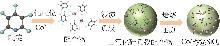
Fig.1
Schematic illustration of synthetic process of Co/Py@SiO2 catalyst"
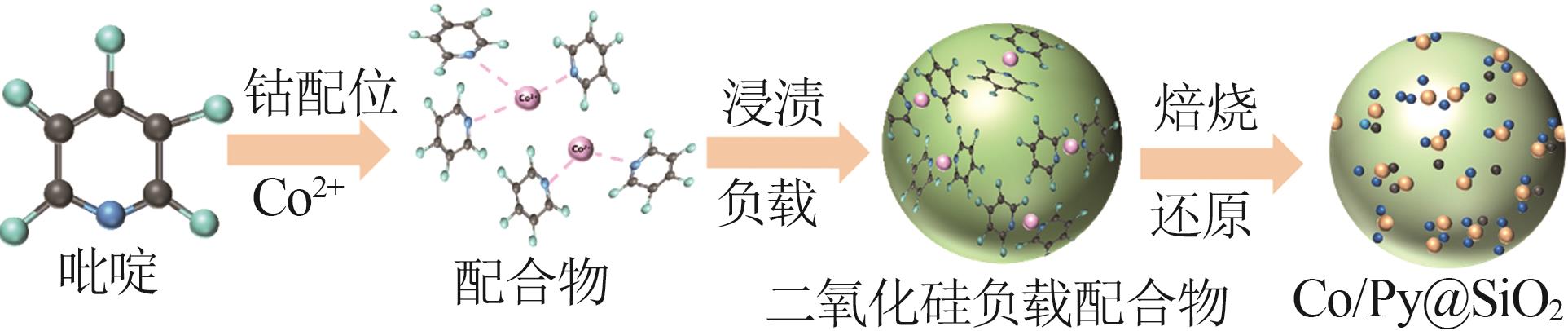
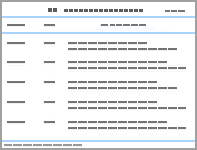
Table 1
Loading contents of Co in different catalysts"
| 序号 | 催化剂物种 | w(1批次 -Co)/% | w(2批次-Co)/% | 备注 |
|---|---|---|---|---|
| 1 | Co@SiO2 | 0.95 | 0.94 | 无配体 |
| 2 | Co/TPP@SiO2 | 0.79 | 0.80 | 三苯基膦 |
| 3 | Co/DMAP@SiO2 | 0.87 | 0.87 | 二甲氨基吡啶 |
| 4 | Co/Py@SiO2 | 0.92 | 0.94 | 吡啶 |
| 5 | Co/MOR@SiO2 | 0.83 | 0.81 | 吗啉 |
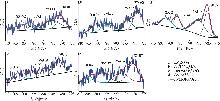
Fig.2
Co 2p XPS spectra of different catalysts"
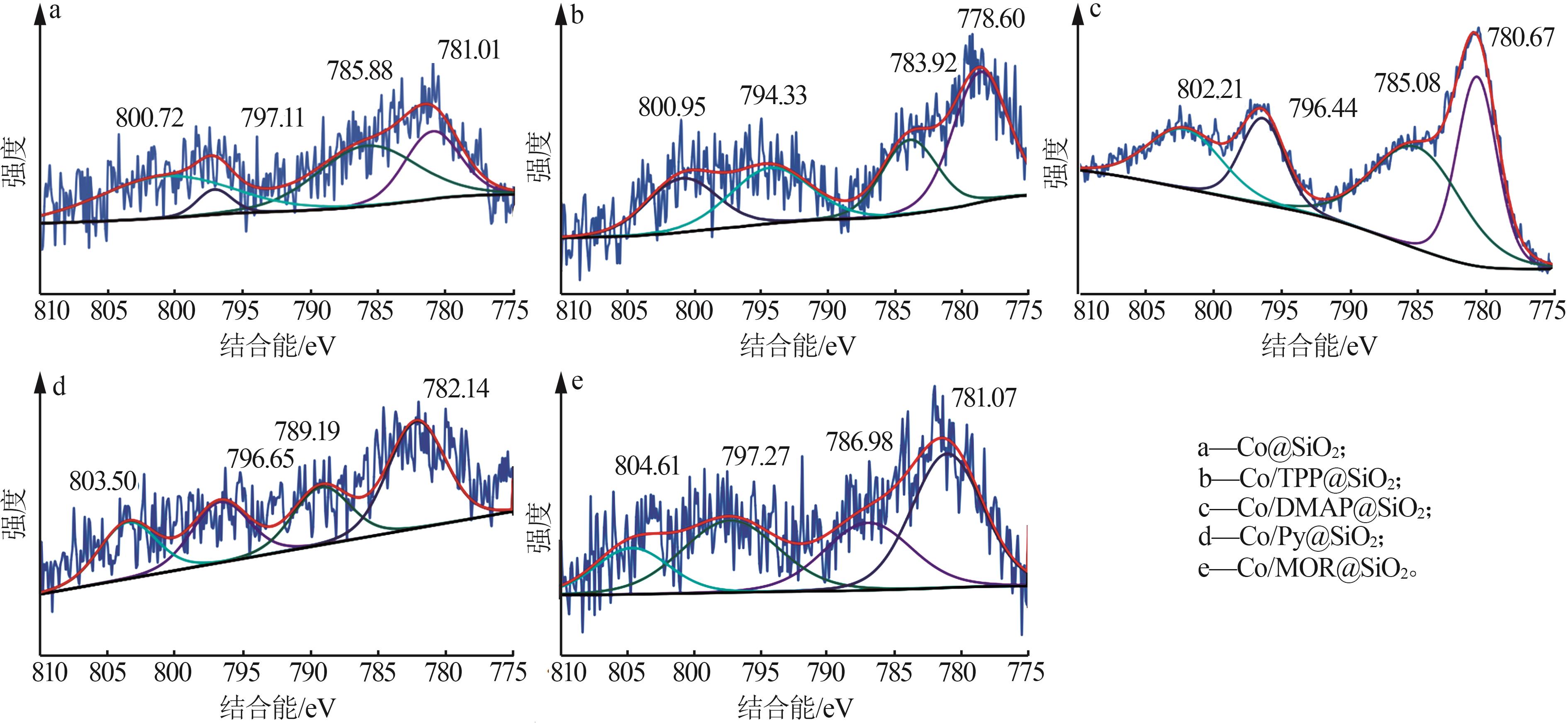
Fig.3
TEM image(a),EDS mapping(b),and EDS dark-field mapping and elemental distribution(c) of Co@SiO2 catalyst"
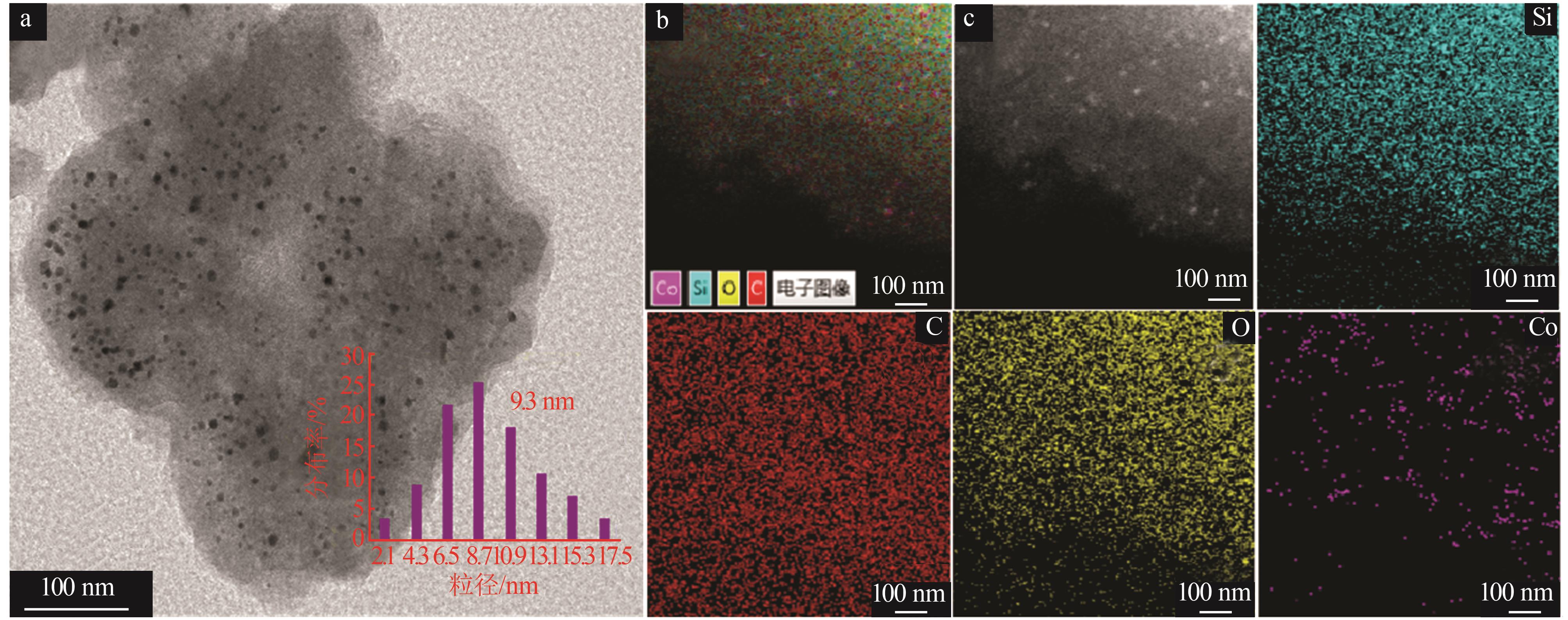
Fig.4
TEM image(a),EDS mapping(b),and EDS dark-field mapping and elemental distributions(c) of Co/TPP@SiO2 catalyst"
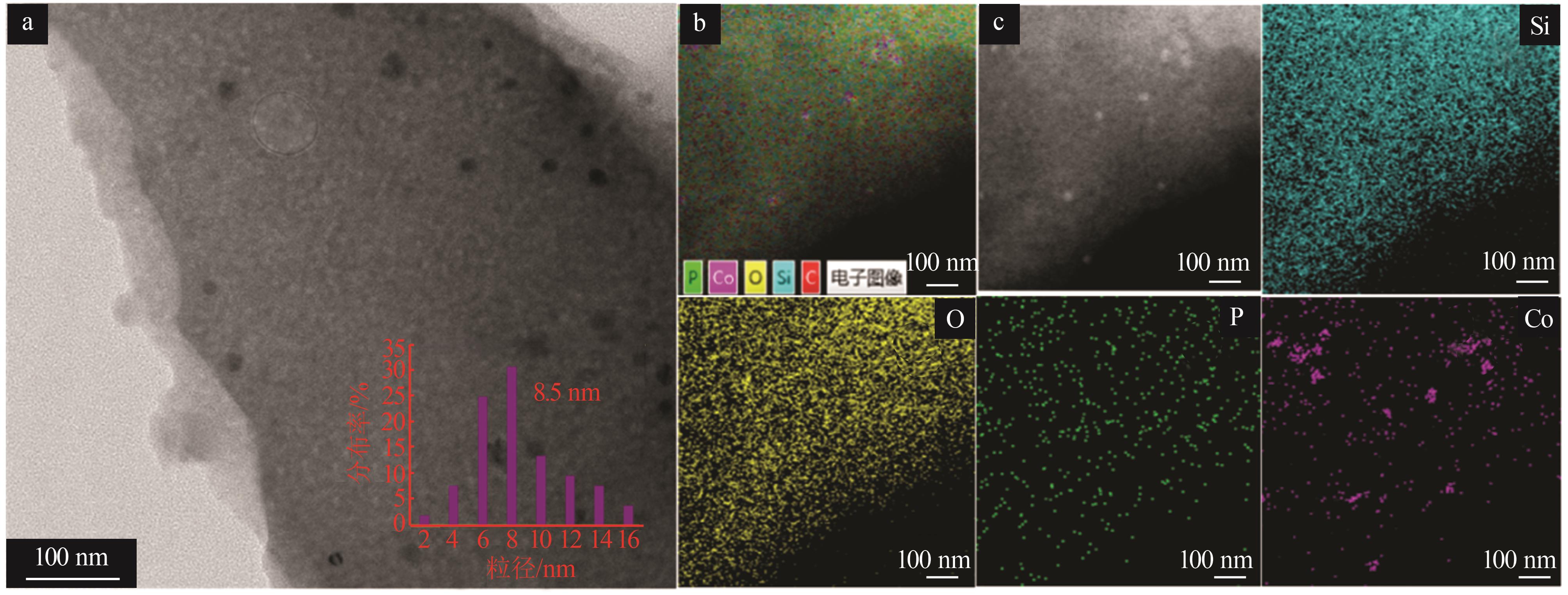
Fig.5
TEM image(a),EDS mapping(b),and EDS dark-field mapping and elemental distributions(c) of Co/Py@SiO2 catalyst"
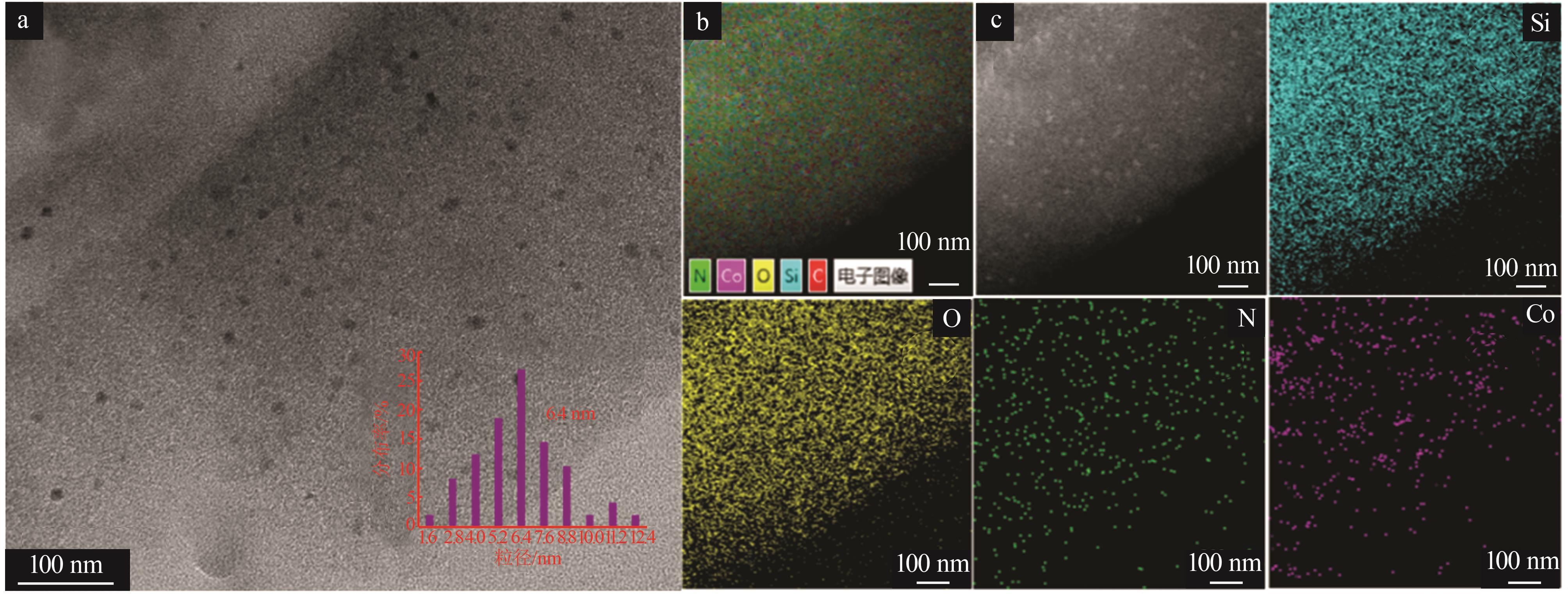
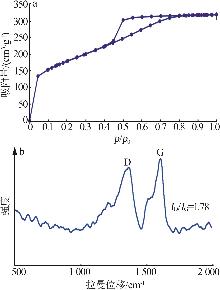
Fig.6
N2 adsorption isotherms(a) and Raman spectrum(b) of Co/Py@SiO2"
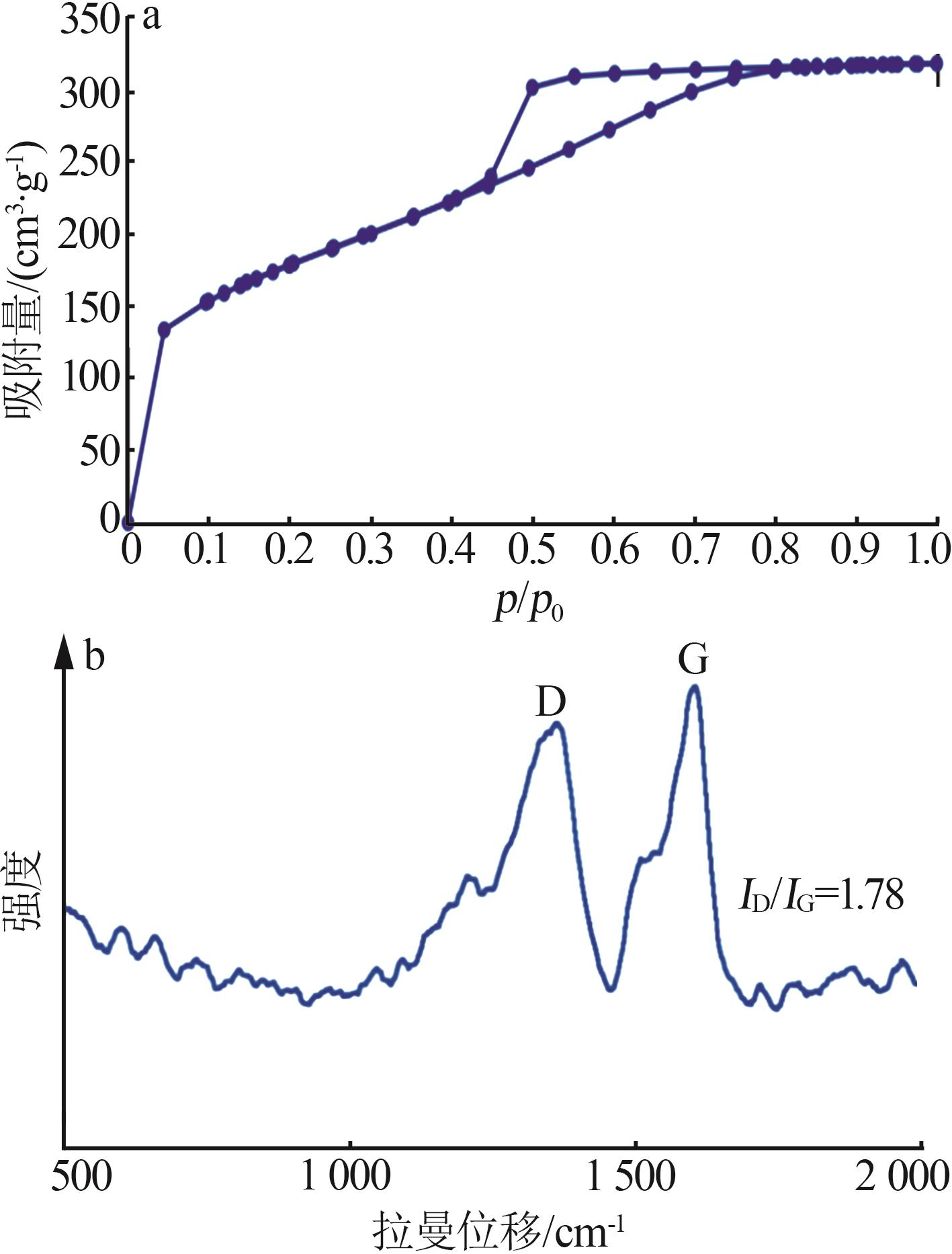
Table 2
Results of nitrogen physisorption and Raman analysis"
| 样品 | 氮气物理吸附 | 拉曼分析 ID/IG | ||
|---|---|---|---|---|
SBET/ (m2·g-1) | Vpore/ (cm3·g-1) | Dpore/ nm | ||
| Co/Py@SiO2 | 618.76 | 0.49 | 3.6 | 1.78 |
Table 3
Hydroformylation of mixed C4 olefins"
| 催化剂 | 混合碳 四转化率/% | 戊醛 收率% | 生成醛 选择性/% | 正戊醛 选择性/% |
|---|---|---|---|---|
| Co@SiO2 | 67.2 | 61.6 | 91.7 | 57.3 |
| Co/TPP@SiO2 | 58.3 | 56.5 | 96.9 | 75.7 |
| Co/DMAP@SiO2 | 68.8 | 62.5 | 90.8 | 80.5 |
| Co/Py@SiO2 | 65.1 | 64.2 | 98.6 | 85.2 |
| Co/MOR@SiO2 | 57.4 | 52.4 | 91.2 | 78.8 |
Table 4
Hydroformylation of 1-octene"
| 催化剂 | 反应底物 | 生成醛 选择性/% | 正构醛 选择性/% |
|---|---|---|---|
| Rh@POP-PTBA-HA-50[ | 1-辛烯 | 96.3 | 88.0 |
| K-Co/SiO2[ | 1-辛烯 | 79.4 | 85.3 |
| Co/Py@SiO2 | 1-辛烯 | 97.2 | 86.2 |
Table 5
Optimization of reaction conditions for hydroformylation of mixed C4 olefins in a fixed-bed reactor"
| 反应条件 | 反应结果 | |||||
|---|---|---|---|---|---|---|
| 温度/℃ | 压力/MPa | 进料流量/(g·h-1) | 混合碳四 转化率/% | 戊醛 收率% | 正戊醛 选择性/% | |
| 140 | 4.0 | 100 | 65.7 | 63.5 | 85.8 | |
| 160 | 4.0 | 100 | 70.2 | 68.2 | 85.4 | |
| 180 | 4.0 | 100 | 71.3 | 69.1 | 83.7 | |
| 160 | 5.0 | 100 | 71.4 | 68.9 | 84.2 | |
| 160 | 4.0 | 120 | 66.8 | 64.6 | 84.1 | |
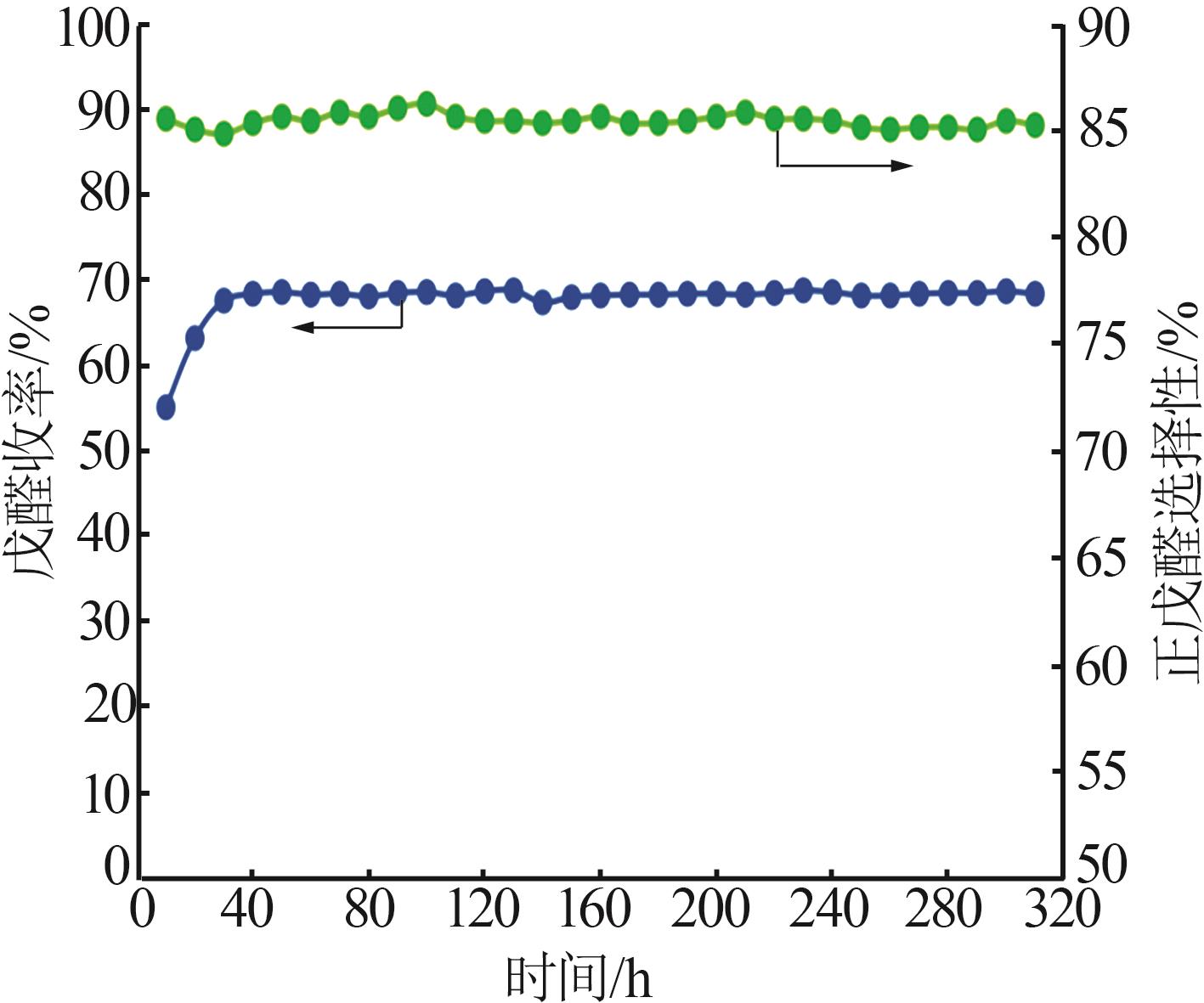
Fig.7
Fixed-bed continuous experiment for hydroformylation of mixed C4 olefins catalyzed by Co/Py@SiO2"
| [1] | POSPECH J, FLEISCHER I, FRANKE R,et al.Alternative metals for homogeneous catalyzed hydroformylation reactions[J].Angewandte Chemie International Edition,2013,52(10):2852-2872. |
| [2] | 齐慧敏,金政伟,何雨航,等.煤基费托α-烯烃均相氢甲酰化反应的规律[J].应用化工,2022,51(S2):13-17. |
| QI Huimin, JIN Zhengwei, HE Yuhang,et al.Hydroformylation of coal-based Fischer-Tropschα-olefinin homogeneous system[J].Applied Chemical Industry,2022,51(S2):13-17. | |
| [3] | ZHANG Baoxin, PEÑA FUENTES D, BÖRNER A.Hydroformyla- tion[J].ChemTexts,2021,8(1):2. |
| [4] | 马萍,和树立,陈述卫,等.负载型烯烃氢甲酰化催化剂研究进展[J].石化技术与应用,2024,42(1):75-82. |
| MA Ping, HE Shuli, CHEN Shuwei,et al.Research progress of supported catalysts for hydroformylation of olefins to aldehyde[J].Petrochemical Technology & Application,2024,42(1):75-82. | |
| [5] | 王鹏飞,胡远明,李晨,等.均相铑膦催化体系下1-癸烯氢甲酰化反应研究[J].无机盐工业,2021,53(3):102-105. |
| WANG Pengfei, HU Yuanming, LI Chen,et al.Study on hydroformylation of 1-decene catalyzed by homogeneous rhodium phosphine[J].Inorganic Chemicals Industry,2021,53(3):102-105. | |
| [6] | 陈万,孙功成,张勇,等.铑基非均相催化剂在烯烃氢甲酰化反应中的应用研究进展[J].低碳化学与化工,2024,49(3):18-29. |
| CHEN Wan, SUN Gongcheng, ZHANG Yong,et al.Research progress on the application of rhodium-based heterogeneous catalysts in olefin hydroformylation[J].Low-Carbon Chemistry and Chemical Engineering,2024,49(3):18-29. | |
| [7] | 马明超,臧甲忠,于海斌,等.贵金属催化剂理性设计在选择性加氢反应中的研究进展[J].无机盐工业,2021,53(7):23- 29. |
| MA Mingchao, ZANG Jiazhong, YU Haibin,et al.Research progress rational design of noble metal catalysts for selective hydrogenation[J].Inorganic Chemicals Industry,2021,53(7):23-29. | |
| [8] | LIU Boyang, WANG Yu, HUANG Ning,et al.Heterogeneous hydroformylation of alkenes by Rh-based catalysts[J].Chem,2022,8(10):2630-2658. |
| [9] | ZHOU Wei, HE Dehua.Lengthening alkyl spacers to increase SBA-15-anchored Rh-P complex activities in 1-octene hydroformylation[J].Chemical Communications,2008(44):5839-5841. |
| [10] | ZHAO Kang, WANG Hongli, WANG Xinzhi,et al.Confinement of atomically dispersed Rh catalysts within porous monophosphine polymers for regioselective hydroformylation of alkenes[J].Journal of Catalysis,2021,401:321-330. |
| [11] | JURADO L, ESVAN J, LUQUE-ÁLVAREZ L A,et al.Highly dispersed Rh single atoms over graphitic carbon nitride as a robust catalyst for the hydroformylation reaction[J].Catalysis Science & Technology,2023,13(5):1425-1436. |
| [12] | BROUSSARD M E, JUMA B, TRAIN S G,et al.A bimetallic hydroformylation catalyst:High regioselectivity and reactivity thr-ough homobimetallic cooperativity[J].Science,1993,260(5115):1784-1788. |
| [13] | KLEIN H, JACKSTELL R, WIESE K D,et al.Highly selective catalyst systems for the hydroformylation of internal olefins to linear aldehydes[J].Angewandte Chemie International Edition,2001,40(18):3408-3411. |
| [14] | GAO Peng, LIANG Guanfeng, RU Tong,et al.Phosphorus coordinated Rh single-atom sites on nanodiamond as highly regioselective catalyst for hydroformylation of olefins[J].Nature Communications,2021,12:4698. |
| [15] | VUNAIN E, NCUBE P, JALAMA K,et al.Confinement effect of rhodium(I) complex species on mesoporous MCM-41 and SBA-15:Effect of pore size on the hydroformylation of 1-octene[J].Journal of Porous Materials,2018,25(1):303-320. |
| [16] | MARRAS F, WANG Jia, COPPENS M O,et al.Ordered mesoporous materials as solid supports for rhodium-diphosphine catalysts with remarkable hydroformylation activity[J].Chemical Co- mmunications,2010,46(35):6587-6589. |
| [17] | Jingrui TI, GONG Kun, CUI Dinghao,et al.K-promoted cobalt-based catalysts for heterogeneous hydroformylation[J].Catalysis Science & Technology,2024,14(4):885-893. |
| [18] | ZHOU Wei, HE Dehua.Anchoring RhCl(CO)(PPh3)2 to-PrPPh2 modified MCM-41 as effective catalyst for 1-octene hydroformylation[J].Catalysis Letters,2009,127(3):437-443. |
| [19] | BAE J A, SONG K C, JEON J K,et al.Effect of pore structure of amine-functionalized mesoporous silica-supported rhodium catalysts on 1-octene hydroformylation[J].Microporous and Mesoporous Materials,2009,123(1/2/3):289-297. |
| [20] | NANDI M, MONDAL P, ISLAM M,et al.Highly efficient hydroformylation of 1-hexene over an ortho-metallated rhodium(I) complex anchored on a 2D-hexagonal mesoporous material[J].European Journal of Inorganic Chemistry,2011,2011(2):221- 227. |
| [21] | 蒋凌云,李晨,李继霞,等.丁辛醇废铑催化剂消解液制备高纯三氯化铑研究[J].无机盐工业,2017,49(11):76-78. |
| JIANG Lingyun, LI Chen, LI Jixia,et al.Study on preparation of high purity rhodium trichloride from digestion solution of spent rhodium catalyst of butyl octanol[J].Inorganic Chemicals Industry,2017,49(11):76-78. | |
| [22] | 李晨,蒋凌云,于海斌.乙酰丙酮二羰基铑(Ⅰ)的制备合成[J].广州化工,2014,42(15):140-141. |
| LI Chen, JIANG Lingyun, YU Haibin.Preparation of acetylacetonatodicarbonylrhodium(Ⅰ)[J].Guangzhou Chemical Industry,2014,42(15):140-141. | |
| [23] | 洪美花,刘冠锋,宫毓鹏,等.介孔二氧化硅KIT-6介观单晶微球的合成[J].无机盐工业,2022,54(7):149-156. |
| HONG Meihua, LIU Guanfeng, GONG Yupeng,et al.Synthesis of mesoporous silica KIT-6 microspheres with single-crystalline mesostructure[J].Inorganic Chemicals Industry,2022,54(7):149-156. | |
| [24] | 易敏,徐士伟,储伟,等.异丁烯氢甲酰化用负载型PPh3-Rh-Co/SiO2配合物高效催化剂[J].分子催化,2005,19(6):486- 489. |
| YI Min, XU Shiwei, CHU Wei,et al.Supported PPh3-Rh-Co/SiO2 complex catalysts for isobutene hydroformylation[J].Journal of Molecular Catalysis,2005,19(6):486-489. | |
| [25] | ZHAO Jiaojiao, HE Yurong, WANG Fei,et al.Suppressing metal leaching in a supported Co/SiO2 catalyst with effective protectants in the hydroformylation reaction[J].ACS Catalysis,2020,10(2):914-920. |
| [26] | 王海京,宗保宁,刘凌涛,等.一种连续制备醛、醇的方法和装置:中国,114478215B[P].2025-02-11. |
| [27] | PEERA S G, BALAMURUGAN J, KIM N H,et al.Sustainable synthesis of Co@NC core shell nanostructures from metal organic frameworks via mechanochemical coordination self-assembly:An efficient electrocatalyst for oxygen reduction reaction[J].Small,2018,14(19):1800441. |
| [1] | SHOU Zhixin, XU Dehua, LIU Yujia, YANG Wengong, WANG Xinlong. Study on thermal decomposition kinetics of sodium fluosilicate [J]. Inorganic Chemicals Industry, 2025, 57(8): 28-34. |
| [2] | PANG Hao, LI Bin, SUN Zhenhai, GUO Jian, CAI Zhe, WU Luming, HONG Meihua, YANG Zhanfeng. Study on adsorption and denitrification performance of iron doped modified SiO2 [J]. Inorganic Chemicals Industry, 2025, 57(6): 49-55. |
| [3] | MA Mingyang, CHEN Minyi, SUN Tao, XUE Bin. Study on preparation and oil/water separation performance of silica-mediated superhydrophobic/superoleophilic hybrid sponge [J]. Inorganic Chemicals Industry, 2025, 57(3): 64-70. |
| [4] | SHEN Xiaoqian, ZHOU Fei, LIU Wanchen, XU Lu, WU Junshu. Study on synthesis of FeS modified calcium silicate hydrate composites and their total Cr removal performance [J]. Inorganic Chemicals Industry, 2025, 57(2): 57-67. |
| [5] | ZHU Jicheng, YANG Qixin, LIANG Haoquan, WANG Zengkun, OUYANG Fugui, DI Jing, GAI Xikun. Effect of confined catalyst Ni@S2 on performance of methane dry reforming reaction [J]. Inorganic Chemicals Industry, 2025, 57(2): 138-146. |
| [6] | YUAN Shengchao, LIU Dajin, LI Weixin, WANG Zhiqi, LIU Siqi, DU Fuling, YU Qianru, WANG Cheng. Analysis for effect of calcium chloride and acetic acid on solidification behavior of silica sol and its mechanism [J]. Inorganic Chemicals Industry, 2025, 57(12): 48-55. |
| [7] | FENG Hao, QIN Meng, HE Zhaoyi, BI Yanli, SONG Yu, DU Youcheng. Effect of silica fume and fly ash on properties of slag-based geopolymer [J]. Inorganic Chemicals Industry, 2025, 57(11): 91-99. |
| [8] | LI Shuai, LI Tianxiang, ZHU Jing, LIU Songlin. Study on purification process of sodium fluoride [J]. Inorganic Chemicals Industry, 2024, 56(9): 90-97. |
| [9] | LEI Xinyu, SUN Henghui, YUAN Xinqiang, ZHANG Wei, JIANG Peng, ZHANG Lizhai. Study on preparation of core-shell structure VO2(M)@SiO2 by silica sol-gel coating [J]. Inorganic Chemicals Industry, 2024, 56(6): 46-54. |
| [10] | DENG Fuli, XIA Zhixiang, LONG Bingwen, ZHANG Yi, DAI Yafen, WANG Bin, DING Yigang. Study on purification process of phosphogypsum by reverse flotation [J]. Inorganic Chemicals Industry, 2024, 56(5): 115-120. |
| [11] | LI Jiangpeng, ZHANG Huibin. Synergistic degradation of methylene blue by photo-Fenton and photocatalytic with 3D porous LaFeO3/CeO2/SrTiO3 [J]. Inorganic Chemicals Industry, 2024, 56(5): 141-148. |
| [12] | DI Lu, WANG Weiguo, CHEN Juexian, WU Chuanshu. Study on preparation of transition metal-supported Silicalite-1 zeolite catalyst and its catalytic performance for furfural hydrogenation [J]. Inorganic Chemicals Industry, 2024, 56(4): 125-132. |
| [13] | WANG Jianping, XUE Xujin, XUE Fengfeng. Study on new process of preparing high-purity aluminium fluoride from fluorosilicic acid [J]. Inorganic Chemicals Industry, 2024, 56(3): 86-90. |
| [14] | LI Yang, LOU Feijian, SUI Xin, LI Keyan, LIU Fei, GUO Xinwen. Preparation of amine-functionalized fumed SiO2 materials and their performance for CO2 adsorption [J]. Inorganic Chemicals Industry, 2024, 56(2): 38-43. |
| [15] | CHEN Xiaohong, YU Yi, ZHU Miao, YE Hengpeng, CHEN Shaohua, LI Yubiao. Study on co⁃reverse flotation process of phosphogypsum for impurity removal and whitening [J]. Inorganic Chemicals Industry, 2024, 56(10): 86-94. |
| Viewed | ||||||
|
Full text |
|
|||||
|
Abstract |
|
|||||
|
||