| [1] |
FUJISHIMA A, HONDA K.Electrochemical photolysis of water at a semiconductor electrode[J].Nature,1972,238(5358):37-38.
|
| [2] |
MA Liang, LU Miao, LI Kexin,et al.Photocatalytic degradation of octadecylamine and 4-dodecylmorpholine over titanium based photocatalyst:Activity and mechanism insights[J].Chemical Engineering Journal,2023,472:144782.
|
| [3] |
CHEN Yan, YANG Weiyi, GAO Shuang,et al.Synthesis of Bi2MoO6 nanosheets with rich oxygen vacancies by postsynthesis etching treatment for enhanced photocatalytic performance[J].ACS Applied Nano Materials,2018,1(7):3565-3578.
|
| [4] |
FAISAL M, AHMED J, ALGETHAMI J S,et al.Facile synthesis of palladium nanoparticles/polypyrrole-carbon black/Bi2O3 ternary na-nocomposite for efficient photocatalytic degradation of colorless and colored pollutants under visible light[J].Arabian Journal of Chemistry,2023,16(12):105349.
|
| [5] |
MANDAL A, BHATTACHARYA G, KARGUPTA K.Enhanced yield of methanol using rGO-Bi2S3/CuO heterojunction photocatalyst for CO2 reduction[J].Journal of Materials Research,2024,39(13):1935-1950.
|
| [6] |
MENG Qingqiang, CAO Chihao, WANG Jing,et al.Atomically thin Bi2MoO6 nanosheets for efficient visible-light photocatalytic nitrogen fixation via O-vacancy tailored exposure of Mo sites[J].ACS Applied Nano Materials,2024,7(13):15808-15818.
|
| [7] |
ARORA I, GARG S, CHAWLA H,et al.Visible light active bismuth chromate/curcuma longa heterostructure for enhancing photocatalytic activity[J].Reaction Kinetics,Mechanisms and Catalysis,2024,137(6):2919-2931.
|
| [8] |
JIMENEZ-RELINQUE E, DAPPOZZE F, BERHAULT G,et al.Bismuth oxyhalide as efficient photocatalyst for water,air treatment and bacteria inactivation under UV and visible light[J].Journal of Photochemistry and Photobiology A:Chemistry,2024,452:115554.
|
| [9] |
PAN Chengsi, BIAN Gaoming, ZHANG Yaning,et al.Efficient and stable H2O2 production from H2O and O2 on BiPO4 photocatalyst[J].Applied Catalysis B:Environmental,2022,316:121675.
|
| [10] |
LENG Weiqi, JIANG Xuefei, HE Sheng,et al.Advanced BiVO4-deoxygenated lignocellulosic photocatalyst for effective degradation of organic and heavy metal pollutants in aqueous system[J].International Journal of Biological Macromolecules,2024,283:137948.
|
| [11] |
CUI Kuixin, QIAN Hui, HE Yuehui,et al.Novel chiral wire-like Bi nanoparticle assembly:In-situ studies on structural evolution from(BiO)2CO3 nanowires under electron-beam irradiation[J].Materials Today Chemistry,2024,42:102394.
|
| [12] |
QI Shuyan, GUAN Ling, ZHANG Ruiyan,et al.Mn doping enhances the photocatalytic performance of Bi2Fe4O9 photocataly- st[J].Optical Materials,2023,142:114112.
|
| [13] |
ZHOU Yangen, ZHANG Yongfan, LIN Mousheng,et al.Monolayered Bi2WO6 nanosheets mimicking heterojunction interface with open surfaces for photocatalysis[J].Nature Communications,2015,6:8340.
|
| [14] |
CHEN Fang, MA Tianyi, ZHANG Tierui,et al.Atomic-level charge separation strategies in semiconductor-based photocatalysts[J].Advanced Materials,2021,33(10):2005256.
|
| [15] |
OSTERLOH F E.Inorganic nanostructures for photoelectrochemical and photocatalytic water splitting[J].Chemical Society Reviews,2013,42(6):2294-2320.
|
| [16] |
GOU Zhenqiong, DAI Jinhang, BAI Jinwu.Synthesis of mesoporous Bi2WO6 flower-like spheres with photocatalysis properties under visible light[J].International Journal of Electrochemical Science,2020,15(11):10684-10693.
|
| [17] |
YANG Wu, ZHOU Fanghe, SUN Ningchao,et al.Constructing a 3D Bi2WO6/ZnIn2S4 direct Z-scheme heterostructure for improved photocatalytic CO2 reduction performance[J].Journal of Colloid and Interface Science,2024,662:695-706.
|
| [18] |
ELAOUNI A, OUARDI M EL, BAQAIS A,et al.Bismuth tungstate Bi2WO6:A review on structural,photophysical and photocatalytic properties[J].RSC Advances,2023,13(26):17476-17494.
|
| [19] |
ZHAO Gang, LIU Suwen, LU Qifang,et al.Fabrication of electrospun Bi2WO6 microbelts with enhanced visible photocatalytic degradation activity[J].Journal of Alloys and Compounds,2013,578:12-16.
|
| [20] |
WANG Xinjun, CHANG Linling, WANG Jinrui,et al.Facile hydrothermal synthesis of Bi2WO6 microdiscs with enhanced photocatalytic activity[J].Applied Surface Science,2013,270:685- 689.
|
| [21] |
LIU Ying, WANG Weimin, FU Zhengyi,et al.Nest-like structures of Sr doped Bi2WO6:Synthesis and enhanced photocataly-tic properties[J].Materials Science and Engineering:B,2011,176(16):1264-1270.
|
| [22] |
马亮,张思远,路淼,等.可见光响应TiO2光催化降解钾肥浮选药剂[J].盐湖研究,2023,31(2):25-35.
|
|
MA Liang, ZHANG Siyuan, LU Miao,et al.Degradation of potassium fertilizer flotation agents by TiO2 with visible-light respon-se[J].Journal of Salt Lake Research,2023,31(2):25-35.
|
| [23] |
马亮,刘伟朝,宋忠梅,等.氧缺陷型光催化剂构建、失活及其稳定性研究进展[J].应用化工,2024,53(9):2165-2171.
|
|
MA Liang, LIU Weichao, SONG Zhongmei,et al.Research progress on the construction,deactivation and stability of oxygen deficient photocatalysts[J].Applied Chemical Industry,2024,53(9):2165-2171.
|
| [24] |
GAO Weihong, LI Geng, WANG Qiuwen,et al.Ultrathin porous Bi2WO6 with rich oxygen vacancies for promoted adsorption-photocatalytic tetracycline degradation[J].Chemical Engineering Jo- urnal,2023,464:142694.
|
| [25] |
WANG Shengyao, XIONG Zhongliang, YANG Nan,et al.Iodine-doping-assisted tunable introduction of oxygen vacancies on bismuth tungstate photocatalysts for highly efficient molecular oxygen activation and pentachlorophenol mineralization[J].Chinese Journal of Catalysis,2020,41(10):1544-1553.
|
| [26] |
XIONG Jie, ZENG Hongyan, YANG Zhuolin,et al.Engineering oxygen vacancies in Bi2WO6 by introducing heteroatoms for enhancing photo-oxidation/reduction activities[J].Ceramics International,2023,49(22):35927-35938.
|
| [27] |
TAYYEBI A, SOLTANI T, HONG H,et al.Improved photocatalytic and photoelectrochemical performance of monoclinic bismuth vanadate by surface defect states(Bi1- x VO4)[J].Journal of Colloid and Interface Science,2018,514:565-575.
|
| [28] |
ANKE B, ROHLOFF M, WILLINGER M G,et al.Improved photoelectrochemical performance of bismuth vanadate by partial O/F-substitution[J].Solid State Sciences,2017,63:1-8.
|
| [29] |
WANG Yinghui, HU Jingcong, GE Teng,et al.Gradient cationic vacancies enabling inner-to-outer tandem homojunctions:Strong local internal electric field and reformed basic sites boosting CO2 photoreduction[J].Advanced Materials,2023,35(31):2302538.
|
| [30] |
BIAN Yuan, ZENG Weixuan, HE Meng,et al.Boosting charge transfer via molybdenum doping and electric-field effect in bismuth tungstate:Density function theory calculation and potential applications[J].Journal of Colloid and Interface Science,2019,534:20-30.
|
| [31] |
ZHANG Liwu, MAN Yi, ZHU Yongfa.Effects of Mo replacement on the structure and visible-light-induced photocatalytic performances of Bi2WO6 photocatalyst[J].ACS Catalysis,2011,1(8):841-848.
|
| [32] |
王泽普,付念,于涵,等.铟掺杂钨位增强钨酸铋氧空位光催化效率[J].物理学报,2019,68(21):263-269.
|
|
WANG Zepu, FU Nian, YU Han,et al.Enhancing oxygen vacancy photocatalytic efficiency of bismuth tungstate using in-doped W site[J].Acta Physica Sinica,2019,68(21):263-269.
|
| [33] |
YU Hongguang, CHU Chenglin.Enhanced visible-light-driven photocatalytic activities for assembled hierarchical Bi2WO6 microspheres by fluorine substitution[J].IOP Conference Series:Materials Science and Engineering,2018,284(1):012002.
|
| [34] |
LI Chunmei, CHEN Gang, SUN Jingxue,et al.Doping effect of phosphate in Bi2WO6 and universal improved photocatalytic activity for removing various pollutants in water[J].Applied Catalysis B:Environmental,2016,188:39-47.
|
| [35] |
DING Xing, ZHAO Kun, ZHANG Lizhi.Enhanced photocatalytic removal of sodium pentachlorophenate with self-doped Bi2WO6 under visible light by generating more superoxide ions[J].Environmental Science & Technology,2014,48(10):5823-5831.
|
| [36] |
WANG Fangzhi, LI Wenjun, GU Shaonan,et al.Samarium and nitrogen Co-doped Bi2WO6 photocatalysts:Synergistic effect of Sm3+/Sm2+ redox centers and N-doped level for enhancing visible-light photocatalytic activity[J].Chemistry:A European Journal,2016,22(36):12859-12867.
|
| [37] |
PENG Diyang, ZENG Hongyan, XIONG Jie,et al.Tuning oxygen vacancy in Bi2WO6 by heteroatom doping for enhanced photooxidation-reduction properties[J].Journal of Colloid and Interface Science,2023,629:133-146.
|
| [38] |
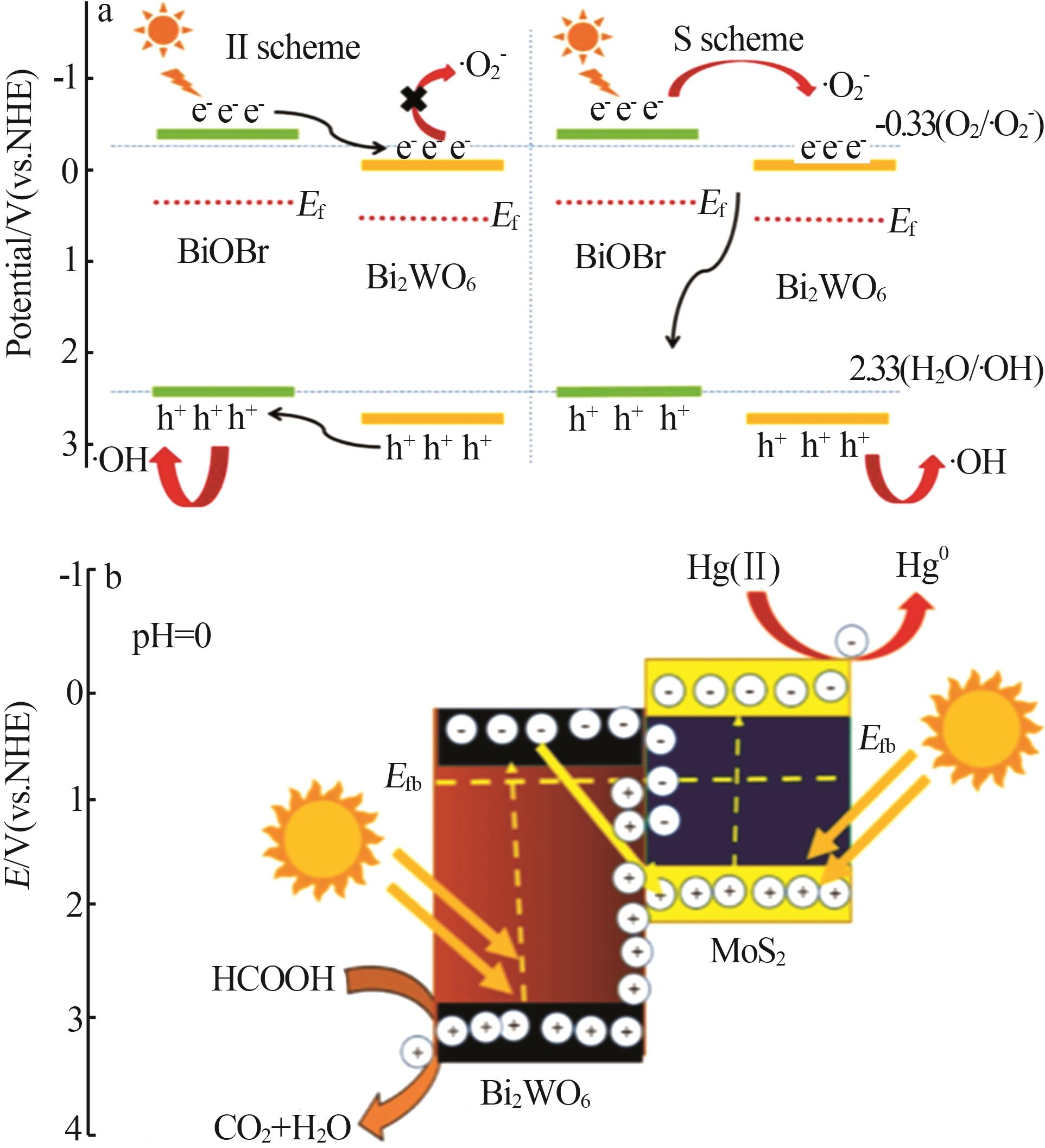
Kang DA, MAO Xiqiang, MA Yuqian,et al.Fabricating BiOBr/Bi2WO6 S-scheme heterojunction with interface modification strategy for efficient photocatalytic degradation of gaseous tolue-ne[J].Materials Today Communications,2024,40:109612.
|
| [39] |
AL-ANAZI A, AL-HAJJI L A, ISMAIL A A,et al.Enhanced Hg(Ⅱ) reduction activity over two-dimensional n-n heterojunction MoS2/Bi2WO6 nanocomposites under visible light illumination[J].Optical Materials,2024,157:116327.
|
| [40] |
LIU Lizhong, WANG Zhongliao, ZHANG Jinfeng,et al.Tunable interfacial charge transfer in a 2D-2D composite for efficient visible-light-driven CO2 conversion[J].Advanced Materials,2023,35(26):2300643.
|
| [41] |
WEN Shengwu, ZHANG Weiyun, YANG Jinlong,et al.Ternary Bi2WO6/TiO2-Pt heterojunction sonosensitizers for boosting sonodynamic therapy[J].ACS Nano,2024,18(34):23672-23683.
|
| [42] |
ZHU Shengbao, XU Tongguang, FU Hongbo,et al.Synergetic effect of Bi2WO6 photocatalyst with C60 and enhanced photoactivity under visible irradiation[J].Environmental Science & Technology,2007,41(17):6234-6239.
|

 ), 王春燕1,2,3, 刘海宁1,2, 李明珍1,2, 宋忠梅1,2,3, 张思远1,2, 叶秀深1,2(