Inorganic Chemicals Industry ›› 2026, Vol. 58 ›› Issue (3): 78-84.doi: 10.19964/j.issn.1006-4990.2025-0164
• Environment·Health·Safety • Previous Articles Next Articles
Study on application of modified phosphogypsum as cement retarder
CHEN Zixiang1( ), ZHANG Qutian1, ZHANG Xia1, ZHANG Long1, YANG Xinyi1, YU Junxia1, LUO Huihua1, CHI Ru′an1,2,3, ZHOU Fang1,2,3()
- 1.School of Resources and Safety Engineering,Wuhan Institute of Technology,Wuhan 430000,China
2.Hubei Three Gorges Laboratory,Yichang 443000,China
3.State Key Laboratory of Green and Efficient Development of Phosphorus Resources,Wuhan 430000,China
-
Received:2025-04-11Online:2026-03-10Published:2026-03-31 -
Contact:ZHOU Fang E-mail:1306796648@qq.com;fzhou@wit.edu.cn

CLC Number:
Cite this article
CHEN Zixiang, ZHANG Qutian, ZHANG Xia, ZHANG Long, YANG Xinyi, YU Junxia, LUO Huihua, CHI Ru′an, ZHOU Fang. Study on application of modified phosphogypsum as cement retarder[J]. Inorganic Chemicals Industry, 2026, 58(3): 78-84.
share this article
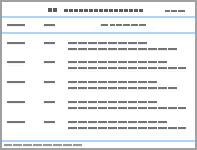
Table 1
Main chemical compositions of raw phosphogypsum %"
| 样品 | (P2O5) | (K2O) | (Na2O) | (SO3) | (CaO) | (SiO2) | (Fe2O3) | (F) |
|---|---|---|---|---|---|---|---|---|
原状 磷石膏 | 1.17 | 0.74 | 0.34 | 47.49 | 39.33 | 8.01 | 0.57 | 1.45 |
Table 2
Main chemical compositions of slag,limestone,and natural gypsum %"
| 样品 | ||||||
|---|---|---|---|---|---|---|
| 天然二水石膏 | 25.04 | 6.35 | 1.29 | 46.08 | 1.06 | 1.55 |
| 水泥熟料 | 61.49 | 22.33 | 5.26 | 0.48 | 3.46 | 3.89 |
| 石灰石 | 50.36 | 5.40 | 1.39 | 0.15 | 0.31 | 2.08 |
| 高炉矿渣 | 34.01 | 34.50 | 17.71 | 1.64 | 1.03 | 6.01 |
Table 3
Component analysis of phosphogypsum samples"
| 样品 | w(可溶性磷)/% | w(可溶性氟)/% | w(总磷)/% | w(总氟)/% | 编号 |
|---|---|---|---|---|---|
| 磷石膏原样 | 0.97 | 0.84 | 1.17 | 1.45 | M1 |
| CaCO3(中) | 0.29 | 0.16 | 0.97 | 1.13 | M2 |
| Ca(OH)2(中) | 0.16 | 0.11 | 1.12 | 1.26 | M3 |
| CaCO3(上) | 0.13 | 0.09 | 0.95 | 1.09 | M4 |
| Ca(OH)2(上) | 0.03 | 0.08 | 0.59 | 0.93 | M5 |
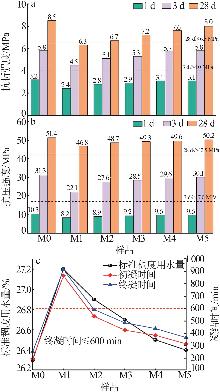
Fig.1
Physical properties of cement made fromdifferent types of phosphogypsum"
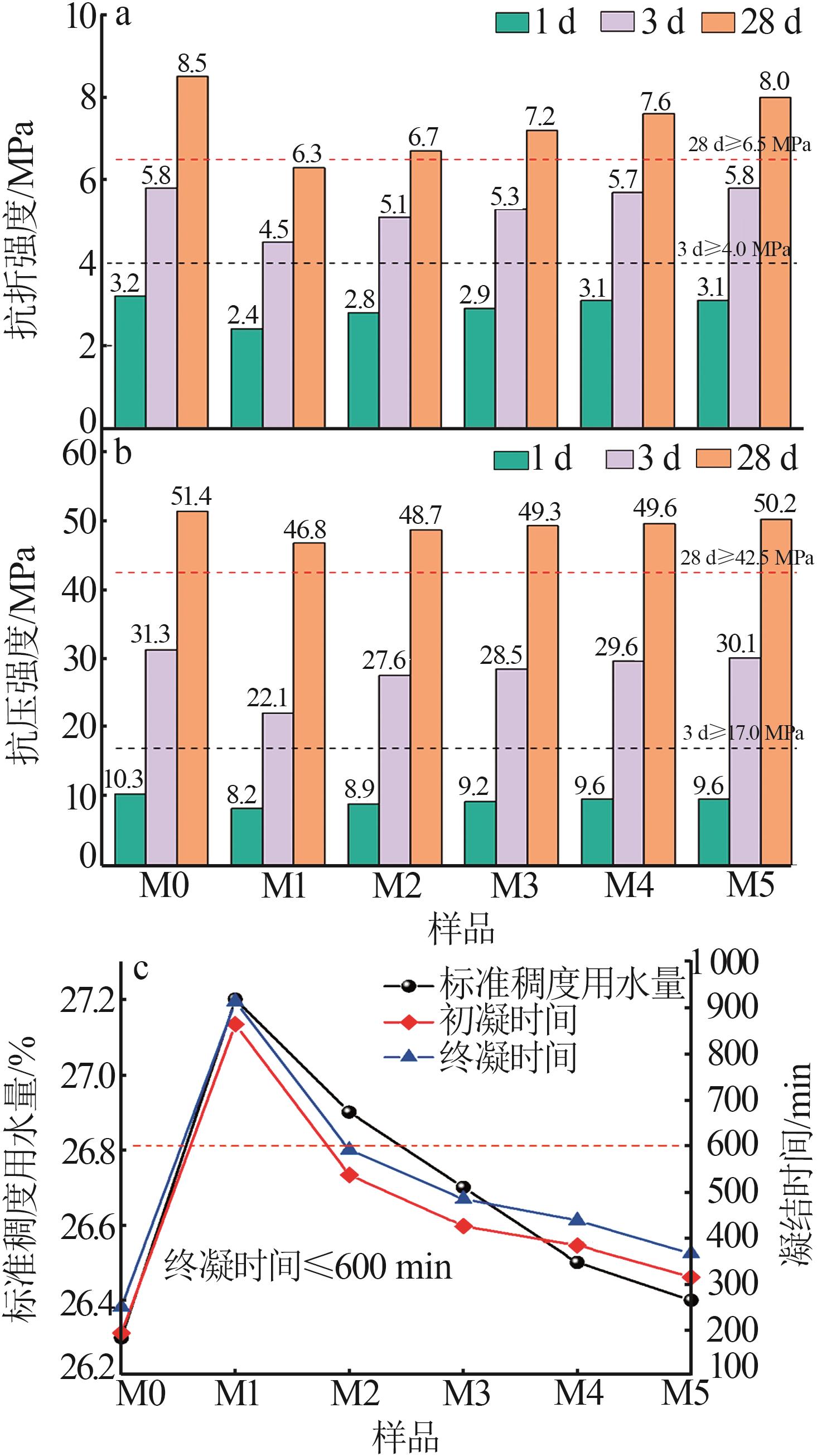
Table 4
Blending scheme of P·O42.5 cement"
矿渣 | ||||||
|---|---|---|---|---|---|---|
| M5-1 | M5 | 84 | 5 | 1 | 4 | 6 |
| M5-2 | M5 | 84 | 4 | 2 | 4 | 6 |
| M5-3 | M5 | 84 | 3 | 3 | 4 | 6 |
| M5-4 | M5 | 84 | 2 | 4 | 4 | 6 |
| M5-5 | M5 | 84 | 1 | 5 | 4 | 6 |
Fig.2
Physical properties of cement compounded with phosphogypsum and natural gypsum"
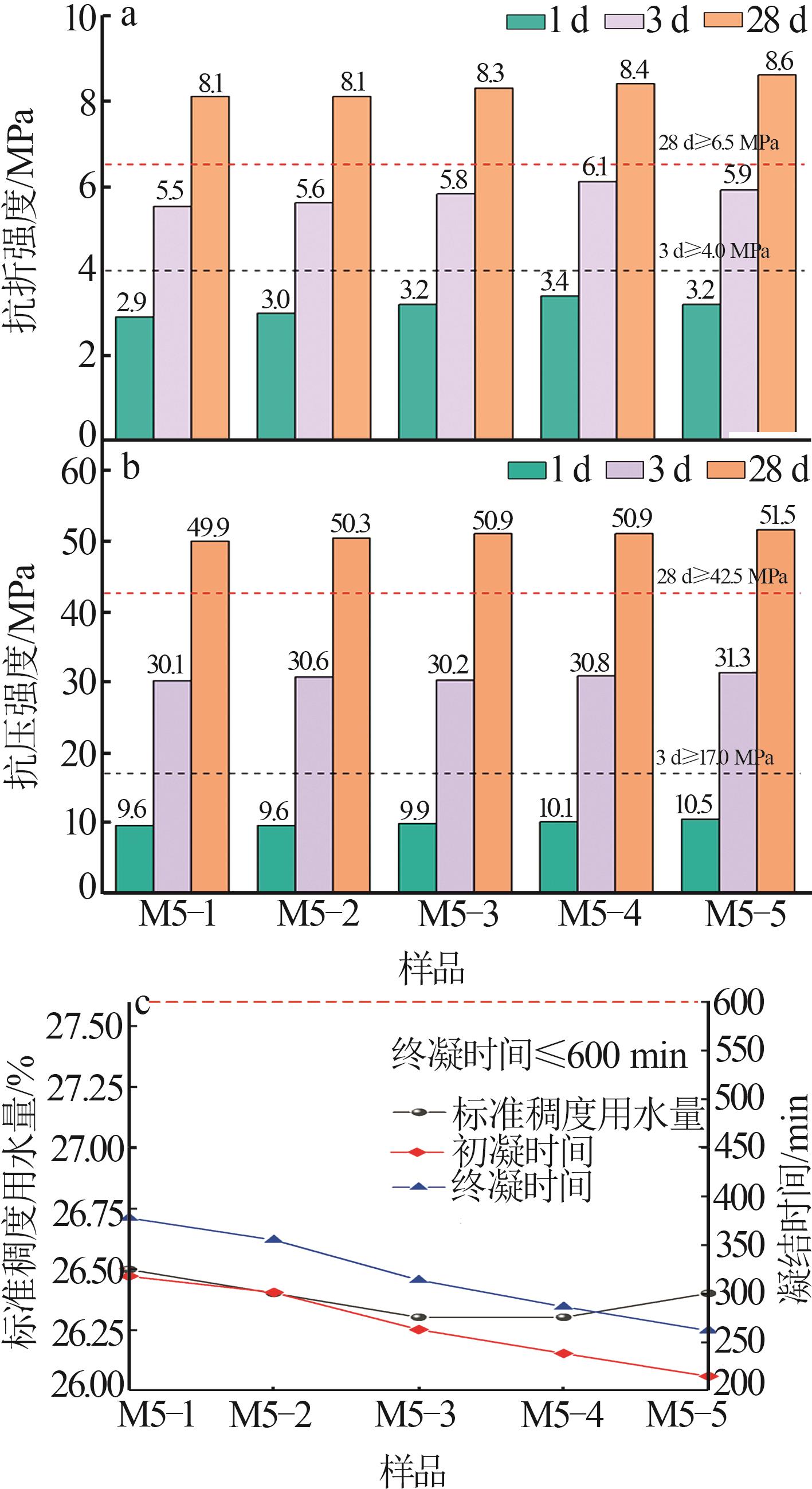
Fig.3
Setting time of different phosphogypsum blended cement pastes"
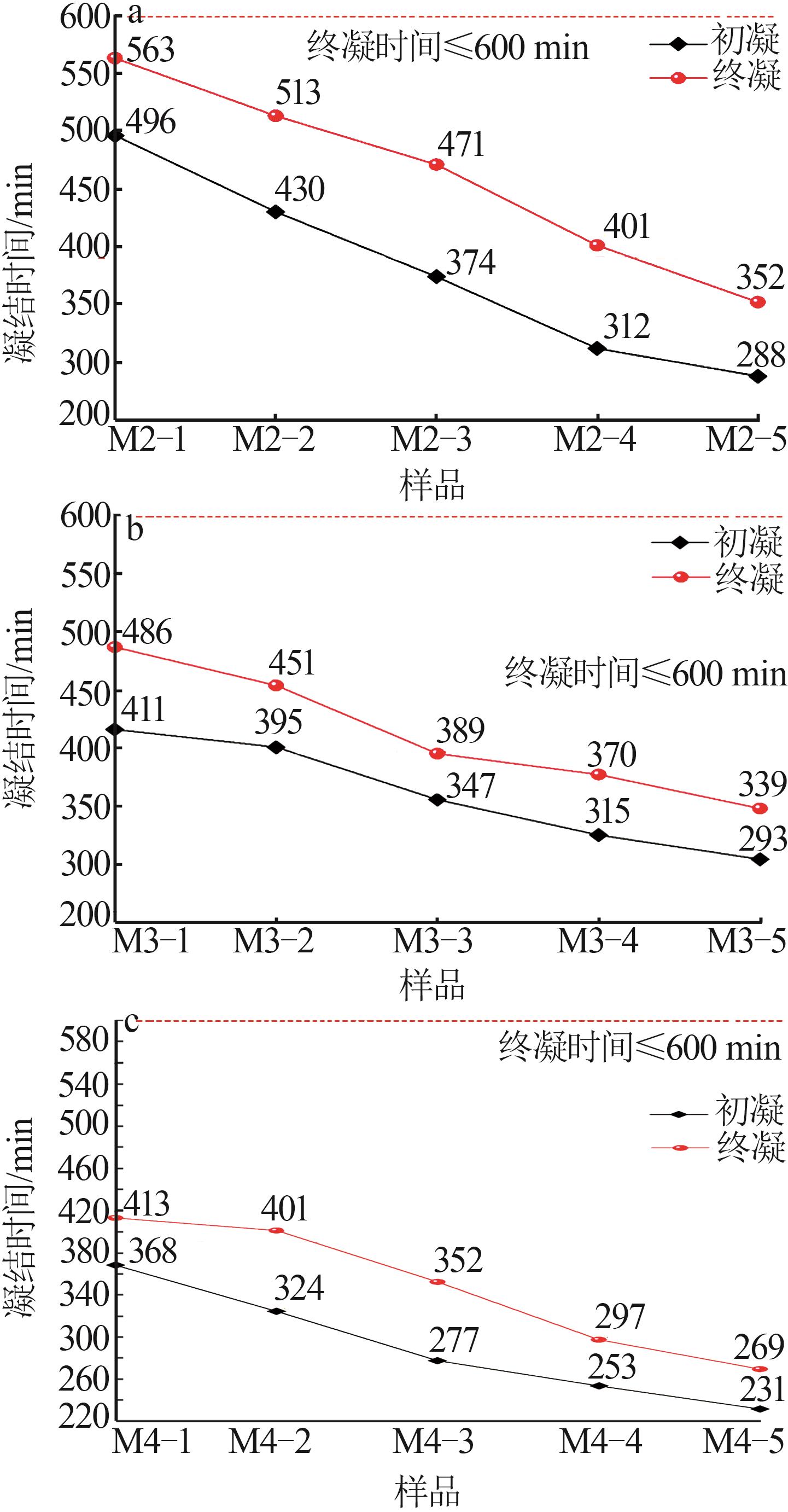
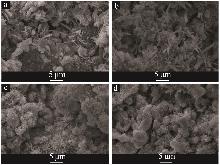
Fig.4
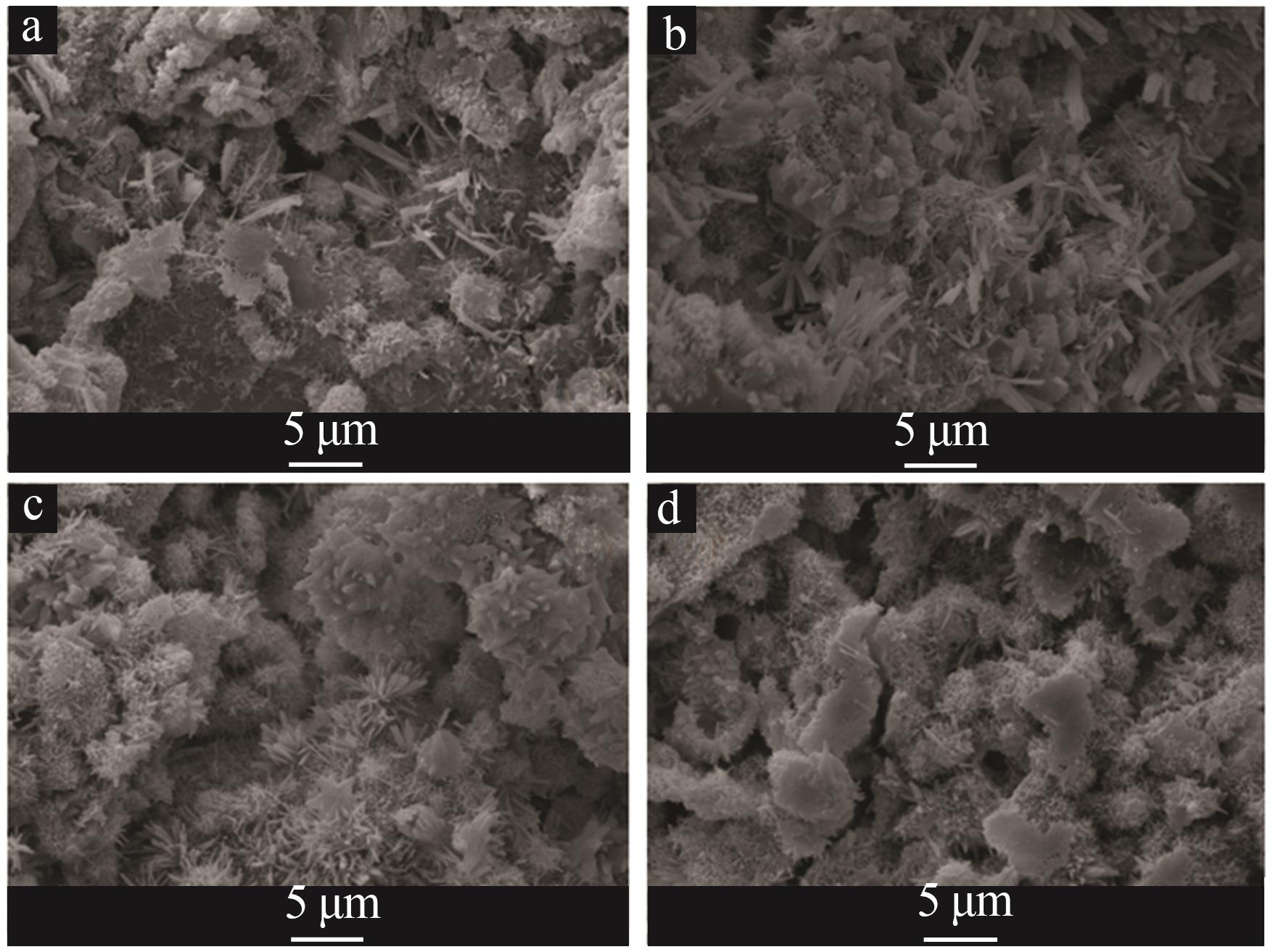
SEM images of hydrated hard body of cement configured with modified phosphogypsum"
| [1] | GASSER M S, ISMAIL Z H, ELGOUD E M ABU,et al.Alkali treatment-acid leaching of rare earth elements from phosphogypsum fertilizer:Insight for additional resource of valuable components[J].BMC Chemistry,2022,16(1):51. |
| [2] | 唐向阳,何新建,谢陈鑫,等.磷石膏资源化研究现状及展望[J].无机盐工业,2025,57(6):18-26. |
| TANG Xiangyang, HE Xinjian, XIE Chenxin,et al.Research status and prospects of phosphogypsum resource utilization[J].Inorganic Chemicals Industry,2025,57(6):18-26. | |
| [3] | 李展,陈江,张覃,等.磷石膏中磷、氟杂质的脱除研究[J].矿物学报,2020,40(5):639-646. |
| LI Zhan, CHEN Jiang, ZHANG Qin,et al.A Study on the removal of phosphorus and fluorine impurities from phosphogypsum[J].Acta Mineralogica Sinica,2020,40(5):639-646. | |
| [4] | 崔荣政,王臣,修学峰.2023年我国磷石膏综合利用情况及产业发展现状分析[J].生态产业科学与磷氟工程,2024,39(11):1-6. |
| CUI Rongzheng, WANG Chen, XIU Xuefeng.Analysis of comprehensive utilization and industrial development status of phosphogypsum in China in 2023[J].Eco-industry Science & Phosphorus Fluorine Engineering,2024,39(11):1-6. | |
| [5] | 邓华,侯硕旻,李中军,等.磷石膏综合利用现状及展望[J].无机盐工业,2024,56(1):1-8,22. |
| DENG Hua, HOU Shuomin, LI Zhongjun,et al.Current situation and prospect of comprehensive utilization of phosphogypsum[J].Inorganic Chemicals Industry,2024,56(1):1-8,22. | |
| [6] | 崔荣政.2021年我国磷石膏综合利用现状及建议[J].磷肥与复肥,2022,37(11):1-3. |
| CUI Rongzheng.Status of comprehensive utilization of phosphogypsum in China in 2021 and suggestions[J].Phosphate & Compound Fertilizer,2022,37(11):1-3. | |
| [7] | 杜明霞,王进明,董发勤,等.磷石膏资源化利用研究进展[J].矿产保护与利用,2020,40(3):121-126. |
| DU Mingxia, WANG Jinming, DONG Faqin,et al.Research progress on resource utilization of phosphogypsum[J].Conservation and Utilization of Mineral Resources,2020,40(3):121-126. | |
| [8] | 周武,李杨,冯伟光,等.磷石膏的综合利用及其在建筑材料领域的应用研究进展[J].硅酸盐通报,2024,43(2):534-542. |
| ZHOU Wu, LI Yang, FENG Weiguang,et al.Research progress on comprehensive utilization of phosphogypsum and its application in the field of building materials[J].Bulletin of the Chinese Ceramic Society,2024,43(2):534-542. | |
| [9] | 汤银浩.工业副产石膏(磷石膏)作为缓凝剂在水泥中的应用[J].江苏建材,2021(4):37-39. |
| TANG Yinhao.Application of industrial by-product gypsum(phosphogypsum) as retarder in cement[J].Jiangsu Building Materials,2021(4):37-39. | |
| [10] | 徐长忠,於金浩,李义连.磷石膏的预处理和综合利用研究进展[J].安全与环境工程,2024,31(1):260-270. |
| XU Changzhong, YU Jinhao, LI Yilian.Research progress of pretreatment and comprehensive utilization of phosphogypsum[J].Safety and Environmental Engineering,2024,31(1):260-270. | |
| [11] | 李恒,张晖,钟晋,等.无水Ⅱ型石膏活性激发及应用研究现状[J].化工矿物与加工,2023,52(5):1-8. |
| LI Heng, ZHANG Hui, ZHONG Jin,et al.Research status on activation and application of Ⅱ-anhydrite gypsum[J].Industrial Minerals & Processing,2023,52(5):1-8. | |
| [12] | 夏晓松,黄军福.磷石膏替代天然二水石膏在水泥生产中的应用研究[J].广州化工,2020,48(22):77-79. |
| XIA Xiaosong, HUANG Junfu.Study on application of phosphogypsum instead of natural dihydrate gypsum in cement producti-on[J].Guangzhou Chemical Industry,2020,48(22):77-79. | |
| [13] | WANG Jinming, DONG Faqin, WANG Zhaojia,et al.A novel method for purification of phosphogypsum[J].Physicochemical Problems of Mineral Processing,2020,56(5):975-983. |
| [14] | 曾明,阮燕,陈晶,等.磷石膏不同预处理方法的效果比较[J].建材世界,2011,32(2):18-21. |
| ZENG Ming, RUAN Yan, CHEN Jing,et al.Effects comparison of different pretreatment methods to phosphogypsum[J].The World of Building Materials,2011,32(2):18-21. | |
| [15] | MURALI G, AZAB M.Recent research in utilization of phosphogypsum as building materials:Review[J].Journal of Materials Research and Technology,2023,25:960-987. |
| [16] | XU Pinjing, LI Hui, CHEN Yanxin.Experimental study on optimization of phosphogypsum suspension decomposition conditions under double catalysis[J].Materials,2021,14(5):1120. |
| [17] | 付全军,罗蜀峰,马先林,等.浸取中和法脱除磷石膏中杂质的研究[J].无机盐工业,2015,47(7):44-47. |
| FU Quanjun, LUO Shufeng, MA Xianlin,et al.Impurities removal from phosphogypsum by leaching neutralization method[J].Inorganic Chemicals Industry,2015,47(7):44-47. | |
| [18] | 田家新,彭伟军,苗毅恒,等.磷石膏漂白—煅烧增白工艺研究[J].矿产保护与利用,2021,41(3):76-80. |
| TIAN Jiaxin, PENG Weijun, MIAO Yiheng,et al.Study on bleaching-calcination whitening process of phosphogypsum[J].Conservation and Utilization of Mineral Resources,2021,41(3):76-80. | |
| [19] | 王进明,董发勤,王肇嘉,等.磷石膏浮选增白净化新工艺研究[J].非金属矿,2019,42(5):1-5. |
| WANG Jinming, DONG Faqin, WANG Zhaojia,et al.Study on new technology of phosphogypsum whitening and purification by flotation[J].Non-Metallic Mines,2019,42(5):1-5. | |
| [20] | 吴泳霖,张伟,奠波,等.磷石膏热分解研究现状[J].硅酸盐通报,2022,41(9):3129-3137. |
| WU Yonglin, ZHANG Wei, DIAN Bo,et al.Research status of phosphogypsum pyrolysis[J].Bulletin of the Chinese Ceramic Society,2022,41(9):3129-3137. | |
| [21] | 李兵,包炜军,郑义文,等.磷石膏净化预处理技术[J].磷肥与复肥,2018,33(3):28-31. |
| LI Bing, BAO Weijun, ZHENG Yiwen,et al.Pretreatment technology for phosphogypsum purification[J].Phosphate & Compound Fertilizer,2018,33(3):28-31. | |
| [22] | 谭明洋,相利学,李国龙.磷石膏净化处理及其对水泥性能的影响[J].水泥工程,2016(2):17-18. |
| TAN Mingyang, XIANG Lixue, LI Guolong.Purification treatment of phosphogypsum and its effect on cement performance[J].Cement Engineering,2016(2):17-18. |
| [1] | ZHENG Ruikai, YI Yun, LIU Qiumei, YANG Lin, CAO Jianxin. Study on hydrothermal dissolution and crystallization behavior of phosphogypsum [J]. Inorganic Chemicals Industry, 2026, 58(2): 83-91. |
| [2] | XIANG Zihao, SUN Changping, CHEN Sifan, HUANG Jiarou, ZHANG Yifan, SHAO Changwei, LI Yang, ZHANG Hua. Research progress on comprehensive utilization of phosphogypsum [J]. Inorganic Chemicals Industry, 2026, 58(2): 10-19. |
| [3] | CHEN Yuanzhi, LI Rui, LI Yubiao, WU Xiaoyong, WU Kaizhen, XUE Lutao, CHI Ru’an. Study on removing impurity and whitening phosphogypsum after flotation by sulfuric acid coupling silane coupling agent [J]. Inorganic Chemicals Industry, 2025, 57(9): 88-95. |
| [4] | GAN Chundan, PAN Yunlian, LIU Hengbo, YANG Jinyan, ZHANG Yunjie, LONG Quan. Study on leaching characteristics of soluble fluoride in phosphogypsum and soil [J]. Inorganic Chemicals Industry, 2025, 57(9): 104-109. |
| [5] | HE Lin, YANG Guanghong, LI Jun. Study on process of reducing loss of eutectic phosphorus in phosphogypsum by dihydrate wet-process phosphoric acid system [J]. Inorganic Chemicals Industry, 2025, 57(9): 30-36. |
| [6] | OUYANG Zijian, CHEN Ping, WEI Jiazhan, LI Changchun, LÜ Wenxin, ZHANG Chengqiang. Study on effect of wet grinding on properties of phosphogypsum-ferronickel slag cementitious materials and hydration mechanism [J]. Inorganic Chemicals Industry, 2025, 57(8): 94-101. |
| [7] | LIU Beibei, LI Zhengtao. Effect of cationic polymer modified graphene oxide on performance of cement-based composites [J]. Inorganic Chemicals Industry, 2025, 57(7): 80-86. |
| [8] | TANG Xiangyang, HE Xinjian, XIE Chenxin, YAN Yan. Research status and prospects of phosphogypsum resource utilization [J]. Inorganic Chemicals Industry, 2025, 57(6): 18-26. |
| [9] | WANG Feng, SONG Yu, HE Zhaoyi, XIA Yuhua, BI Yanli, FENG Hao, CAO Dongwei. Study on mechanical properties and microscopic characterization of phosphogypsum composite cementitious materials [J]. Inorganic Chemicals Industry, 2025, 57(5): 93-99. |
| [10] | LONG Qijun, WU Qin, TAO Jia, CHEN Chuanxiang, WANG Jianxiang, YU Fang. Study on mechanical properties of high content modified hemihydrate phosphogypsum wall materials [J]. Inorganic Chemicals Industry, 2025, 57(4): 89-96. |
| [11] | ZHAO Mengyan, CHEN Junwu, WANG Xun, WEI Na, WENG Xiaoqing, CHEN Yingxin. Study on purification of phosphogypsum by reverse flotation of octadecyl trimethyl ammonium chloride and its removal mechanism of quartz [J]. Inorganic Chemicals Industry, 2025, 57(4): 111-117. |
| [12] | SHI Wangfang, ZHANG Yongsheng. Study on NO x degradation performance of concrete-based non-metallic boron doped nitrogen-rich carbon nitride [J]. Inorganic Chemicals Industry, 2025, 57(3): 116-123. |
| [13] | LENG Manxi, ZHU Yu, YAN Jikang, XIE Ke, ZOU Yongjie. Study on crystallization characteristics and mineral flotation performance of industrial waste phosphogypsum [J]. Inorganic Chemicals Industry, 2025, 57(3): 108-115. |
| [14] | TAN Shanyi, WEN Huizi, HE Shuyu, ZHANG Liwen, CHEN Shaohua, XI Benjun. Study on leaching behavior and kinetics of phosphorus from phosphogypsum [J]. Inorganic Chemicals Industry, 2025, 57(2): 105-112. |
| [15] | YUAN Shengchao, LIU Dajin, LI Weixin, WANG Zhiqi, LIU Siqi, DU Fuling, YU Qianru, WANG Cheng. Analysis for effect of calcium chloride and acetic acid on solidification behavior of silica sol and its mechanism [J]. Inorganic Chemicals Industry, 2025, 57(12): 48-55. |
| Viewed | ||||||
|
Full text |
|
|||||
|
Abstract |
|
|||||
|
||